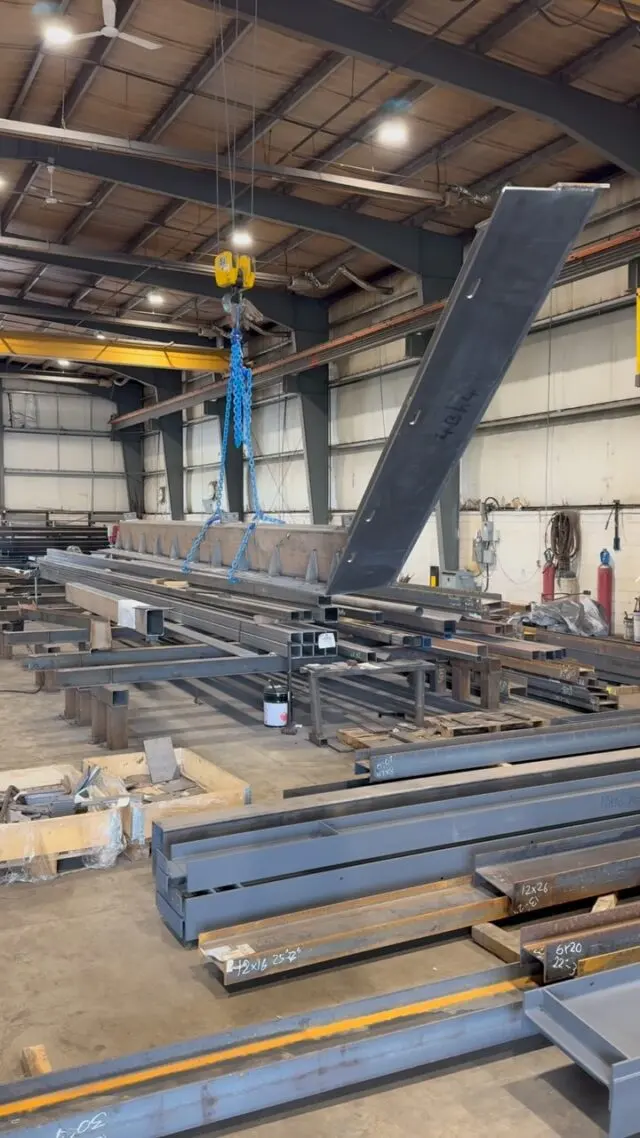
Steel fabrication is the whole process of turning steel stock into finished parts: reading the drawings, cutting, drilling, fitting, joining, finishing and marking. Welding is one way of joining those parts, and it is only one step in fabrication. Most fabricators weld, but plenty of fabricated steel has no welding at all, and a welder is not automatically a fabricator. For structural work in Canada, the welding is done by companies certified by the Canadian Welding Bureau (CWB) to CSA W47.1, by welders qualified under that certification.
This post explains the difference between the two, the trades and certifications behind them, and who to call for what.
Fabrication vs welding at a glance
| Fabrication | Welding | |
|---|---|---|
| What it is | Making finished parts from stock material, to drawings | Joining metal by melting and fusing it |
| Steps involved | Layout, cutting, drilling or punching, fitting, joining, bending, finishing, marking | Joint preparation, welding, cleaning, inspection |
| Joining methods | Welding, bolting, or none | Welding only |
| Starting point | Shop drawings or design drawings | A joint and a welding procedure |
| Typical output | Beams with connections, posts with plates, lintels, stairs, rebar shapes | A completed weld |
| Ontario trade | Metal Fabricator (Fitter), 437A | Welder, 456A |
| Company certification for structural work | CWB certification to CSA W47.1 where welding is involved | Welders qualified under a CWB certified company |
What fabrication includes
Take a simple basement beam with a post. Before it leaves the shop, it goes through:
- Drawings. Shop drawings show every cut, hole, plate and weld. Our post on how to read structural steel drawings explains what is on them.
- Cutting. The beam and post are cut to length with a saw, and plates are cut from flat stock by shearing, sawing or thermal cutting.
- Holes. Bolt holes are drilled or punched in plates, angles or flanges.
- Fitting. Plates and clips are positioned on the member, squared and held in place.
- Joining. The fitted parts are welded, or in some designs bolted.
- Finishing. Welds are cleaned, sharp edges ground, and the piece is primed, painted or galvanized as specified.
- Marking and shipping. Each piece is marked to match the erection drawings and bundled for delivery.
Welding is step 5. Getting everything else right is what makes the piece fit on site. Our step-by-step guide to how a steel beam is fabricated follows a beam through the shop, and types of steel fabrication processes covers the main cutting, forming and joining methods.
Where welding fits
Welding joins steel by melting the base metal and a filler metal together so they fuse. In structural fabrication it is used to attach base plates and cap plates to posts, shear tabs and stiffeners to beams, and to build up stair stringers, frames and misc steel.
For structural steel in Canada, the key standards are:
- CSA W59, the structural welding code, which covers how welds are designed, made and inspected. Our post on CSA W59 explains it.
- CSA W47.1, which certifies companies that weld steel. For steel designed to CSA S16, which the Ontario Building Code references, the fabricators and erectors doing the welding are required to be certified to W47.1.
Welding happens in two places. Shop welding is done under controlled conditions with good access and positioning, which is why most welding is done before the steel ships. Field welding is done on site where a connection cannot be made in the shop, and it is slower, weather-dependent and harder to inspect. Our post on structural welding services compares the two.
Fabricator vs welder: trades and certifications
The words "fabricator" and "welder" each describe both a person and, loosely, a business. That causes much of the confusion.
As trades, Ontario recognizes both:
- Welder (456A), a Red Seal trade focused on welding processes, joint preparation and weld quality.
- Metal Fabricator (Fitter) (437A), a Red Seal trade that builds, assembles and repairs metal products. Skilled Trades Ontario describes the work as interpreting drawings, operating machinery, layout and measurement, and welding.
Both trades are non-compulsory in Ontario, which means a certificate is not legally required to do the work. On structural jobs, the requirement that matters is the CWB one.
As companies, a steel fabricator is a shop that takes drawings and delivers finished steel. A fabricator doing structural welding holds CWB certification to CSA W47.1 and employs welders qualified under it. A welding business may be a mobile welder doing repairs, a production welding shop, or a fabricator.
On structural work, the company's certification is what counts. Individual welders are tested for the processes and positions they weld, and under W47.1 they work within a certified company's procedures and supervision. Our post on how to check CWB certification explains how to confirm a company is certified.
Fabrication without welding
Not all fabricated steel is welded. Examples:
- Bolted connections. Many beam connections are bolted on site through holes drilled or punched in the shop. Our post on bolted vs welded beam connections covers when each is used.
- Cut-to-length members. A loose lintel angle or a plain beam cut to length is fabricated but not welded.
- Drilled and punched parts. Base plates and connection plates cut and drilled to a template.
- Bent and rolled steel. Plate and sections formed to shape.
- Rebar fabrication. Reinforcing bar is cut and bent in the shop with no welding at all. Welding of rebar falls under a separate standard, CSA W186, and is rare; see can rebar be welded.
So the answer to "is metal fabrication welding?" is: often it includes welding, sometimes it doesn't, and it always includes more than welding.
Who to call for what
| Job | Who you need |
|---|---|
| Repair a broken hinge or bracket on a non-structural gate or trailer | A welder, often mobile |
| New steel beam and posts for a basement | A structural steel fabricator, with an engineer's design and a permit where required |
| Lintels for new window or door openings | A fabricator, working to the designer's sizes |
| Adding plates or reinforcing to an existing structural beam | A CWB certified company, working to an engineer's detail |
| Custom stairs, railings or gates | A fabricator; installation by your contractor or installer |
| Rebar for footings, walls and slabs | A rebar fabricator, cut and bent to a bar list |
The rule of thumb: if it starts with a drawing and ends as a new part, you want a fabricator. If it is structural, you want CWB certification and an engineer's design behind it.
Fabrication and welding under one roof
We fit, cut, weld, grind, mark and bundle structural steel to your shop drawings, prepare those shop drawings in-house, and can prime or galvanize to suit. Our shop welding is certified by the Canadian Welding Bureau. We also supply and install structural steel and rebar, from basement beams and posts to larger commercial projects, and fabricate miscellaneous steel for your installer. Send your drawings for a free quote, or see our services.
Frequently asked questions
Is steel fabrication the same as welding?
No. Fabrication is the whole process of turning steel stock into finished parts: reading drawings, cutting, drilling, fitting, joining, finishing and marking. Welding is one of the ways parts are joined during fabrication. Most fabricators weld, but fabrication also includes a lot of work that is not welding.
Does metal fabrication include welding?
Usually, yes. Most structural and miscellaneous steel fabrication includes welding, for example plates welded to beams and posts. But some fabricated parts, such as bolted beams, punched lintels or cut and bent rebar, involve no welding at all.
What is the difference between a fabricator and a welder?
A welder specializes in joining metal by welding. A fabricator, as a trade or a company, builds complete parts from drawings, which involves layout, cutting, fitting and often welding. In Ontario, Welder (456A) and Metal Fabricator (Fitter) (437A) are separate Red Seal trades.
Do I need a fabricator or a welder?
For a repair to an existing non-structural item, a welder may be all you need. For a new beam, post, lintel or anything made from drawings, you need a fabricator. For welding that is part of a building's structure, use a company certified by the Canadian Welding Bureau to CSA W47.1.