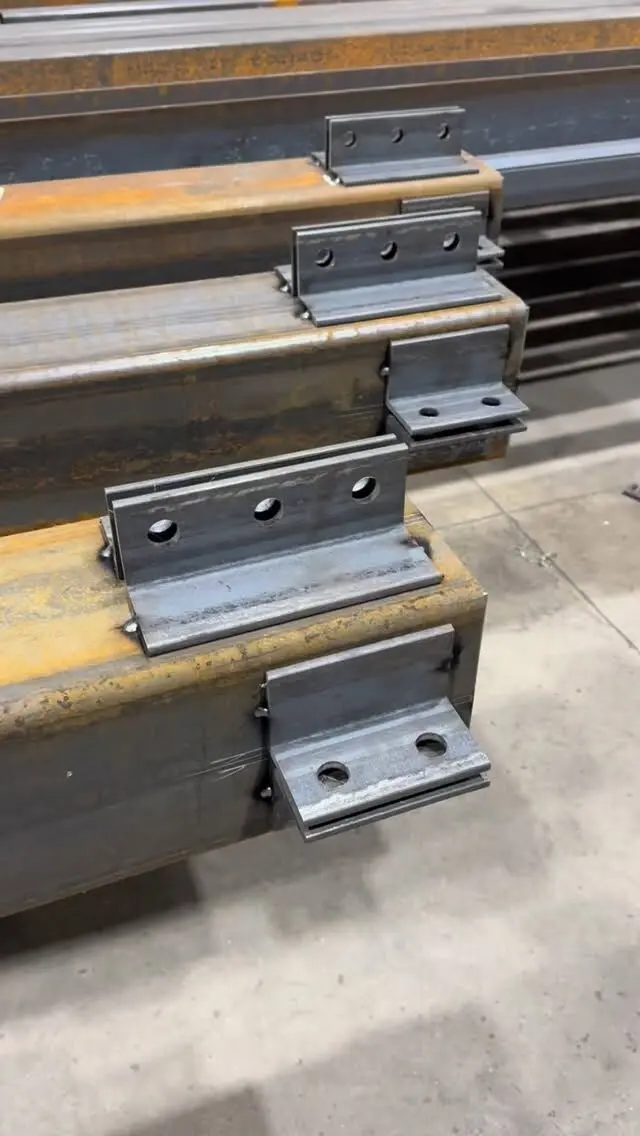
Structural welding services cover the welds that hold load-carrying steel together: beam connections, base and cap plates, built-up members, bracing and repairs. Most of it should happen in the fabrication shop, where welds are made in good positions, under cover, by certified welders working to approved procedures. Field welding is used where a connection can't be bolted or a piece can't be finished in the shop. Either way, structural welds in Canada are made by CWB-certified companies to CSA W59.
This post explains how shop and field welding differ, how to decide where welds should be made, and what drives the price of structural welding.
What counts as structural welding
Structural welding is any welding on steel that carries load in a building or structure. Common examples:
- Connection plates: shear tabs, end plates and clip angles welded to beams and columns.
- Base plates and cap plates on columns and posts.
- Moment connections, where flanges are welded to transfer bending, often with full-penetration groove welds.
- Built-up members: plates welded into girders, box sections or reinforced beams.
- Bracing and gussets, stair stringers, lintels with welded plates.
- Repairs and reinforcement of existing steel, such as adding plates to an undersized beam.
Welding rebar is a separate discipline with its own standard, CSA W186, and only weldable grades should be welded. See can rebar be welded?
Shop welding vs field welding
| Shop welding | Field welding | |
|---|---|---|
| Welding position | Pieces can be turned so most welds are flat or horizontal | Whatever position the connection is in, often vertical or overhead |
| Environment | Indoors, dry, out of the wind | Weather, wind, cold and wet surfaces |
| Access | Clear access on all sides | At height, from lifts or scaffolds, near other trades |
| Fit-up | Jigs, clamps and cranes hold parts accurately | Pieces held by temporary bolts or bracing |
| Inspection | Easy to inspect before the piece ships | Needs scheduling, access and sometimes testing on site |
| Safety | Controlled shop setting | Hot work on an active site: fire watch, protection of adjacent materials |
| Productivity | High | Lower, with more set-up time per weld |
The practical result is a long-standing rule in steel construction: weld in the shop, bolt in the field wherever the design allows. The fabricator welds plates and connection pieces to members in the shop, then the erector bolts the pieces together on site. We compare the two connection types in bolted vs welded steel beam connections.
When field welding makes sense
Field welding isn't a failure of planning. Some work genuinely needs it:
- Moment frames where the engineer has specified welded flange connections.
- Steel deck welded to supporting beams.
- Embedded plates in concrete that receive steel on site.
- Renovations, where new steel connects to existing steel that can't come out.
- Fit-up corrections approved by the engineer of record.
- Members too large to ship in one piece, spliced on site.
When field welds are on the drawings, plan for them early. They need a certified company, qualified welders for the positions involved, access, weather protection in winter, and an inspection plan.
Certification and the codes behind structural welding
Three things have to line up on every structural weld:
- The company is certified. CSA S16, the steel design standard the Ontario Building Code references, requires fabricators and erectors who weld under it to be certified by the Canadian Welding Bureau to CSA W47.1 (Division 1 or 2), CSA W55.3, or both. That covers field welding crews as well as the shop. See why hire a CWB-certified fabricator.
- The welder is qualified. Each welder is tested for the process and position they weld in. A ticket for flat welding doesn't qualify someone for overhead field welds.
- The weld follows CSA W59. W59 covers the design of welded connections, consumables, base metals, workmanship, inspection and quality levels. Our guide to CSA W59 explains what it covers.
Requirements such as preheat for thick material, weld profiles and acceptance criteria come from W59 and the approved welding procedures. Those are matters for the welding supervisor and engineer, and the right values depend on the steel, the thickness and the process.
Welding on existing steel
Renovation and repair work brings its own welding questions. Before welding to an existing beam or column, the engineer needs to know what the steel is, because older steel may not have the same chemistry or weldability as current grades. Paint, rust and fireproofing have to be removed from the weld area, and the heat from welding can affect nearby wood framing, finishes and services, so fire protection and a fire watch are part of the plan. Often the better answer is to fabricate reinforcing plates or new members in the shop and bolt or weld them on site with as little field welding as possible.
Inspection and testing
On most structural projects, welds are visually inspected by the fabricator's quality control. The specification may also call for:
- Third-party inspection by an inspection organization, often hired by the owner.
- Non-destructive testing such as ultrasonic or magnetic particle testing on critical welds, especially full-penetration welds.
- Documentation: welding procedure data sheets, welder qualifications and inspection reports for the submittal file.
Shop welds are easier to inspect and repair before the steel ships. A defect found in the field costs far more to fix, which is another reason to keep welding in the shop.
What drives the cost of structural welding
We don't publish welding rates, because the cost of a weld depends almost entirely on the details. The main drivers:
- Weld type and size. A small fillet weld is quick. A large multi-pass groove weld on thick plate takes much longer and may need preheat and testing.
- Number of connections. Ten identical connections are cheaper per weld than ten different ones.
- Position. Flat welding is fastest. Vertical and overhead welds are slower.
- Shop or field. Field welding adds travel, set-up, access equipment, weather protection and fire watch.
- Access and site conditions: working at height, in an occupied building, or around finished surfaces.
- Inspection and testing required by the specification.
- Surface condition on renovation work, where existing paint or coatings have to be removed before welding.
For a quote that compares like with like, send the drawings and say whether the welding is shop, field or both. Our article on custom steel fabrication cost covers the wider picture.
Questions to ask a structural welding contractor
- Which CWB certification do you hold, and does it cover field welding?
- Are your welders qualified for the positions on this job?
- Who is your welding supervisor?
- How will field welds be protected from weather in winter?
- What inspection is included, and can you provide documentation for submittals?
- Can any field welds be changed to bolted connections or moved into the shop?
CWB-certified welding at Procut Steel
Our shop welding is certified by the Canadian Welding Bureau. We fit, cut, weld, grind and mark structural steel to the shop drawings, which we prepare in-house, so connection plates, base plates and stiffeners arrive welded and ready to install. We also supply and install structural steel on residential, commercial and larger projects. If your job has field welds, ask us how they will be handled when you request a quote.
Send us your drawings for a free take-off and quote, or see our fabrication services.
Frequently asked questions
Is shop welding better than field welding?
For most structural work, yes. In the shop, pieces can be turned so welds are made in the easiest position, the environment is controlled and inspection is simpler. Field welding is used where it can't be avoided, such as some moment connections, deck, embeds and repairs.
Does structural welding need to be CWB certified in Ontario?
For steel designed to CSA S16, which the Ontario Building Code references, the companies that weld it, in the shop or in the field, are required to be certified by the Canadian Welding Bureau. Check what your project's engineer specifies.
What is a structural welder?
A welder who makes welds on load-carrying steel such as beams, columns, base plates and connections. In Canada, the welder is qualified for the process and position, and works for a company certified to CSA W47.1 that follows CSA W59 for the welds.
What affects the cost of structural welding?
Weld type and size, the number of connections, welding position, whether the work is in the shop or the field, access, weather protection, and inspection or testing requirements. Field welding generally costs more than the same weld made in the shop.