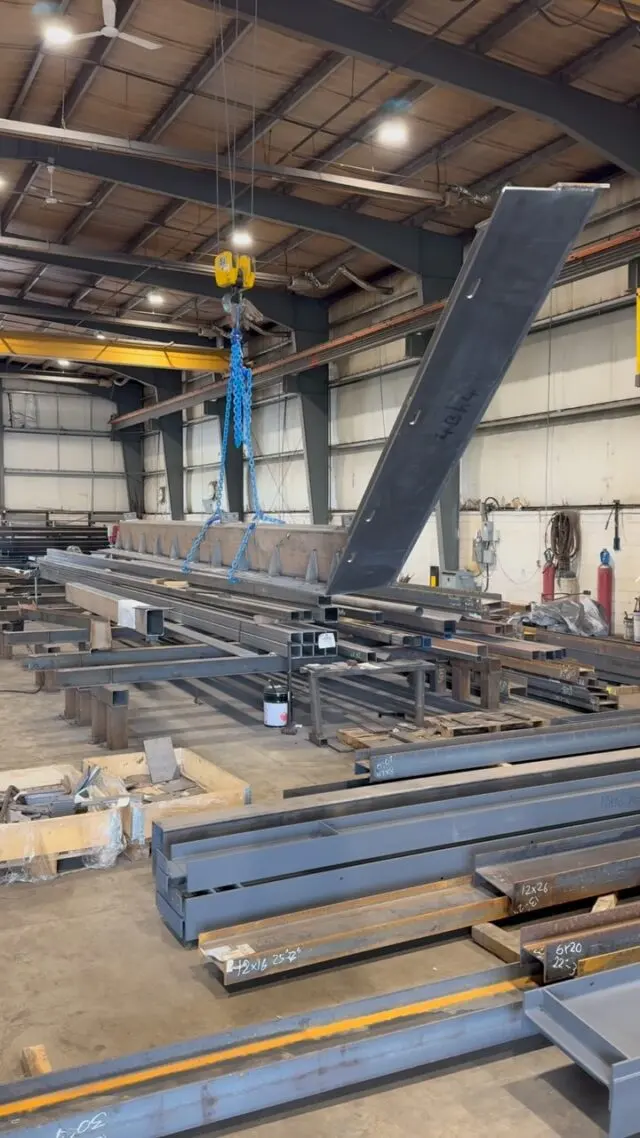
Steel fabrication is a sequence of a few basic process types: cutting the steel to size, making holes and copes, forming it into shape, joining pieces by welding or bolting, and finishing the surface. Each type has several methods, and a fabricator picks the method that suits the material, thickness, accuracy and finish the job needs. A single beam with end plates might be sawn, drilled, fitted, welded, ground and primed before it ships.
This post is a catalogue of those processes, and of the main types of metal fabrication shops. If you want to follow a structural piece through the shop in order, see the structural steel fabrication process, step by step.
The five process families
| Process family | What it does | Common methods |
|---|---|---|
| Cutting | Brings material to length and shape | Sawing, shearing, oxy-fuel, plasma, laser, waterjet |
| Holemaking | Makes bolt holes, copes and openings | Drilling, punching, thermal cutting, coping |
| Forming | Changes the shape of the steel | Press brake bending, roll bending, cambering, rebar bending |
| Joining | Connects pieces into assemblies | Welding, bolting, fitting |
| Finishing | Prepares and protects the surface | Grinding, blast cleaning, priming, painting, galvanizing |
Every fabricated piece starts from a drawing. The shop drawings say what each piece looks like, and the detailer's numbers drive every cut and hole.
Cutting processes
Cutting is the first process almost every piece goes through.
| Method | How it works | Best suited to |
|---|---|---|
| Band or circular sawing | A blade cuts through the section | Beams, channels, angles and HSS cut to length; square and accurate ends |
| Shearing | A blade shears the steel in one stroke | Plate, flat bar, angle and rebar; fast, no heat |
| Oxy-fuel cutting | Preheated steel is burned away by a jet of oxygen | Thick plate, copes, site work |
| Plasma cutting | An electric arc and gas jet melt through the steel | Plate in a range of thicknesses, faster and cleaner than oxy-fuel on thinner plate |
| Laser cutting | A focused beam melts or vaporizes the steel | Thinner plate and sheet where tight accuracy and fine detail matter |
| Waterjet cutting | High-pressure water with abrasive erodes the steel | Parts that cannot take heat, or mixed materials |
Thermal methods (oxy-fuel, plasma, laser) leave a heat-affected edge. For most structural plates that is fine, but some edges, such as those that will be welded with a groove weld or that sit in fatigue-loaded connections, may need grinding or a specified cut quality. The engineer and the fabricator's procedures cover this.
Rebar has its own version of cutting: bars are sheared to the lengths on the bar list, then bent.
Holemaking and coping
Bolted steel needs accurate holes, and beams that frame into other beams often need their flanges cut away.
- Drilling makes clean, round holes in any thickness. Multi-spindle beam drill lines drill flanges and webs in one setup.
- Punching forces a punch through the steel. It is fast but limited by thickness: CSA S16 restricts full-size punching to thinner material relative to the hole size, so thicker parts are drilled, or sub-punched and reamed.
- Thermal cutting of holes is limited for bolt holes and is done only where the standard and the engineer allow it. It is more common for large openings, such as access holes in plate.
- Coping cuts away part of a flange so a beam can frame into another beam or a column without clashing. Copes are cut with a radius at the corner, not a sharp notch, to avoid starting a crack.
- Slotted and oversize holes give adjustment for erection, where the engineer allows them.
Adding holes or copes to an existing beam on site is a different matter: it needs the engineer's approval first.
Forming processes
Forming changes the shape of the steel without removing material.
- Press brake bending folds plate and sheet into angles, channels, bent plates and brackets. A bent plate is sometimes used instead of a rolled angle where an odd size is needed.
- Roll bending curves plate into cylinders and cones, or curves beams, channels and tube into arcs for curved stairs, canopies and features.
- Cambering puts a slight upward curve in a beam so it ends up level once the floor or roof load is on it. It is done with heat (heat cambering) or with mechanical presses (cold cambering). See heat cambering vs cold cambering.
- Straightening corrects distortion from welding or handling, using heat or press force.
- Rebar bending cold bends reinforcing bar around a pin to standard shapes, such as hooks, stirrups, ties and L-bars.
Forming has limits set by the steel's grade and thickness, such as a minimum inside bend radius. The fabricator works these out for the material on the job.
Joining processes
Joining turns cut and formed parts into assemblies.
- Fitting comes first: plates, stiffeners and clips are positioned and tack welded in place, checked against the drawing, then welded out.
- Welding fuses pieces together. Structural shops use mainly shielded metal arc (stick), flux cored, gas metal arc and submerged arc welding, with stud welding for shear studs. Our comparison of structural welding processes explains where each is used, and structural weld types and sizes covers fillet and groove welds.
- Bolting joins pieces with high strength bolts. Most bolting happens during erection, but some assemblies are bolted in the shop.
In Canada, structural welding is done by companies certified by the Canadian Welding Bureau, working to written welding procedures.
Finishing processes
Finishing protects the steel and gets it ready for site.
- Grinding removes weld spatter, sharp edges and burrs, and blends welds where needed.
- Blast cleaning removes mill scale and rust before coating when the specification calls for it.
- Priming and painting apply a shop coat, or a full paint system, to the surfaces the specification calls for, leaving bare any surfaces marked as no paint.
- Hot dip galvanizing dips the finished piece in molten zinc for long-term corrosion protection, typically on exterior steel. Pieces are designed with vent and drain holes so the zinc can flow in and out.
Types of metal fabrication shops
"Metal fabricator" covers several kinds of shop, each built around different processes.
| Type of shop | Typical work | Main processes |
|---|---|---|
| Structural steel fabricator | Beams, columns, bracing, connections, lintels, posts | Sawing, drilling, fitting, welding, cambering, coating |
| Miscellaneous metals fabricator | Stairs, railings, ladders, embeds, lintels | Cutting, bending, fitting, welding, finishing |
| Plate and heavy fabricator | Tanks, hoppers, large weldments | Plate cutting, rolling, heavy welding |
| Sheet metal shop | Ductwork, flashing, enclosures | Shearing, press brake, laser, spot welding |
| Rebar fabricator | Cut and bent reinforcing bar | Shearing, bending, tagging and bundling |
| Machine and job shops | Precision parts and one-offs | Machining, turning, milling, welding |
Many shops do more than one of these. When you hire one, match the shop to the work, and for structural work make sure it holds the welding certification the job requires. Our guide on choosing a structural steel fabricator in Ontario covers what to check.
Fabrication at Procut
Our shop fits, cuts, welds, grinds, marks and bundles structural steel to the shop drawings, with CWB-certified welding and heat cambering of beams where specified. We can prime or galvanize structural and miscellaneous steel to suit the job. On the rebar side, we shear bar to length and bend it to all standard shapes, from 10M to 55M, then tag and bundle it to your bar list.
Send us your drawings for a free take-off and quote, or see our full list of services.
Frequently asked questions
What are the main types of metal fabrication processes?
Cutting (sawing, shearing, oxy-fuel, plasma, laser and waterjet), holemaking (drilling, punching, coping), forming (bending, rolling, cambering), joining (welding and bolting) and finishing (grinding, blast cleaning, priming, painting and galvanizing).
What is the difference between structural and miscellaneous steel fabrication?
Structural fabrication makes the load-carrying frame: beams, columns, bracing and their connections. Miscellaneous steel fabrication makes the secondary items such as stairs, railings, ladders, lintels and embeds. The processes overlap; the drawings, standards and tolerances differ.
Which cutting method is best for steel?
It depends on the part. Saws give square, accurate cuts on beams and tube. Shears are fast for plate, angle and rebar. Oxy-fuel handles thick plate, plasma and laser give faster, cleaner cuts on thinner plate, and waterjet cuts without heat. Fabricators pick the method to suit thickness, accuracy and edge requirements.
Is welding the same as fabrication?
No. Welding is one joining process within fabrication. Fabrication also includes reading drawings, cutting, holemaking, forming, fitting, bolting, finishing, marking and quality control.