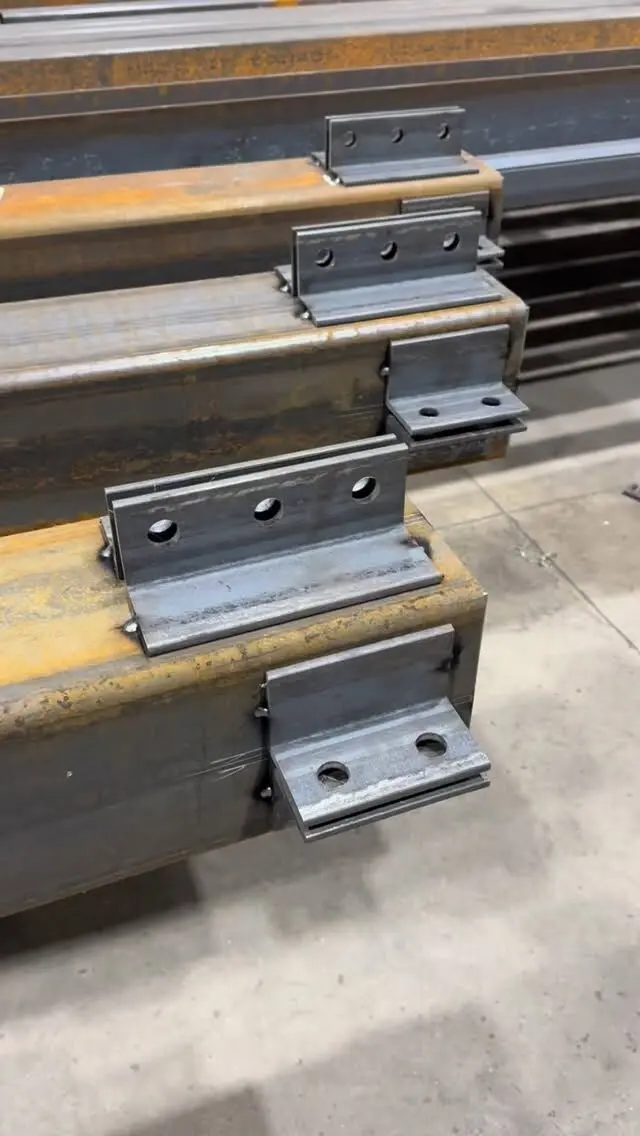
A steel angle cleat, usually called a clip angle in Canada, is a short length of angle that connects one steel member to another: typically bolted or welded to the web of a beam and then bolted or welded to a column, girder or wall. A ledger angle is a longer angle fastened along a beam or wall to act as a shelf that other members bear on. Both are among the most common pieces of steel on any job, and both are designed parts of the structure, not filler.
This post covers the types of cleat and ledger angles, how angle-to-angle connections work, and what the fabricator needs on the drawings. For the full range of beam-to-column connections, including the ones that do not use angles, see our post on types of steel beam-to-column connections.
Cleat, clip or angle connector: same part, different names
The terminology varies by country and trade:
- Clip angle: the usual North American term for a short angle connecting a beam to its support.
- Cleat: the same part in British, Australian and Asian practice, and common in steel detailing generally. "Web cleat" and "angle cleat" both mean a clip angle on the beam web.
- Angle clip or steel angle clip: the same, or sometimes a smaller angle used for secondary items like girts, purlins or brackets.
- Angle connector: in timber framing, often means a light-gauge pressed steel bracket sold by connector manufacturers. Those are proprietary products with their own load ratings and are a different thing from a structural clip angle cut from hot-rolled angle.
On Canadian structural drawings, the angle is described by size, for example L89x89x7.9, with its length and its bolt or weld pattern. Our steel angle size chart explains the designation.
Types of cleat angle in steel structures
Double clip angles (web cleats)
Two angles, one on each side of the supported beam's web, bolted or welded to the web and to the support. This is one of the most common simple shear connections in steel buildings. It is symmetric, it is flexible enough to act as a simple connection, and it is easy to erect when the angles are shop-attached to the beam and field-bolted to the column.
Single clip angle
One angle on one side of the web. It is used where access is tight or the reaction is small, and it is common in miscellaneous framing. Because the load is on one side, the eccentricity has to be accounted for in the design.
Seat angle and top angle
A seat angle is fastened to the column or wall below the beam, and the beam's bottom flange sits on it. A small top angle (or a side angle on the web) keeps the beam from rolling. Seated connections are handy when the beam has to be dropped into place between two supports, and on connections to the column web where access for bolting from the side is awkward. A stiffened seat adds a vertical plate or angle under the seat for heavier reactions.
Erection seat
A small angle shop-welded to a column to support a beam temporarily while the permanent connection is bolted or welded. It makes field fit-up safer and quicker, particularly where the permanent connection is a field weld.
Bracing and secondary cleats
Short angles welded or bolted to columns and beams to pick up braces, girts, purlins, lintels and miscellaneous supports. On a pre-engineered or industrial building there can be hundreds of these, and getting them all on the shop drawings is a large part of the detailing work.
Steel angle ledgers and shelf angles
A ledger angle runs along the side of a member to support something that bears on its outstanding leg:
- On a steel beam: a ledger angle welded or bolted along the web or flange to carry joists, wood framing, metal deck edges or precast planks. It lets floor framing bear at a lower level than the top of the beam.
- On a concrete or masonry wall: an angle anchored to the wall, or welded to embed plates cast into it, to carry joists or a slab edge.
- Shelf or relieving angles: continuous angles that carry brick veneer at floor lines, fastened to the slab edge or spandrel beam. These are closely related to loose steel lintels over masonry openings.
A wood ledger or nailer fastened to a steel beam is a related detail; our post on attaching a wood nailer to a steel beam covers that.
Ledger angles look simple, but the engineer has to check the angle leg in bending, the fasteners or welds that hold it, and the effect of the eccentric load on the member it hangs from. Slotted holes are often specified where the angle meets concrete, to absorb construction tolerances.
Steel angle to angle connections
Angles are often connected to each other:
- Double angles back to back. Two angles with their vertical legs side by side, a gap between them for a gusset plate. Used as truss members, braces and hangers. Short filler or stitch plates at intervals tie the two angles together so they act as one member.
- Lapped angles. One angle's leg lapped over another and bolted or welded, common in light frames and supports.
- Angle to angle at a corner. For frames and curbs, the ends are mitred and welded, or one angle's leg is cut back (coped) so the other fits flat against it.
- Angle splices. Where an angle is too long to ship or has to be joined, a splice angle or plate laps across the joint.
In every case, holes are set out on gauge lines measured from the heel of the angle so they clear the fillet and leave enough edge distance to the toe. Our post on steel angle heel, toe and gauge lines explains how that works.
Shop attached or field attached
Each clip angle is attached to one member in the shop and to the other in the field. The choice affects shipping, erection and cost:
| Approach | Advantages | Watch for |
|---|---|---|
| Clips shop-welded to the beam, field-bolted to the column | Clean column, quick erection, welding done in the shop | Beam length must be right; clips stick out and can be damaged in shipping |
| Clips shop-bolted or welded to the column, beam field-bolted | Beam can be dropped in; fine where the beam has to be swung into place | Column handling with projecting clips |
| Clips shipped loose | Allows adjustment on site | More field work, more pieces to track |
Connections to existing concrete or masonry usually leave the anchoring for the field, with slotted or oversized holes in the angle approved by the engineer.
What to put on the drawings
For clip and ledger angles, the fabricator needs:
- Angle size and grade, for example L102x102x9.5 in 350W.
- Length of each clip, or the extent of each ledger.
- Hole size, gauge and pitch, or weld size and length.
- Which member it is attached to in the shop, and which connection is made in the field.
- Finish: bare, primed or galvanized. We can prime or galvanize to suit.
Most of this is settled on the shop drawings, which the engineer reviews. Our post on types of structural steel connections gives the bigger picture of bolts and welds in connections.
Get your connection steel fabricated
We cut, punch or drill and weld clip angles, seat angles and ledger angles to your drawings, attach them in our CWB certified shop, and mark every piece to match the shop drawings, which we prepare in-house. Send your drawings through our quote request, or see our fabrication services.
Frequently asked questions
What is a steel angle cleat?
A short piece of steel angle used to connect one member to another, usually bolted or welded to a beam web and to a column or girder. In Canada and the US it is more often called a clip angle; cleat is the common term in the UK, Australia and elsewhere.
What is a ledger angle?
A continuous or long angle fastened along the side of a beam or wall to give other members something to bear on, such as joists, deck, precast planks or a wood ledger. It works like a shelf rather than a connection between two members.
What is the difference between a clip angle and a seat angle?
A clip angle connects to the web of the supported beam and carries the reaction through bolts or welds in shear. A seat angle sits under the bottom flange so the beam bears on it, usually with a small top or stabilizing angle to stop the beam rolling.
Are clip angles designed by an engineer?
Yes. The angle size, length, thickness, bolts and welds depend on the reaction it carries. Many are standard details from the connection designer, but they still come from a design, not from a rule of thumb.