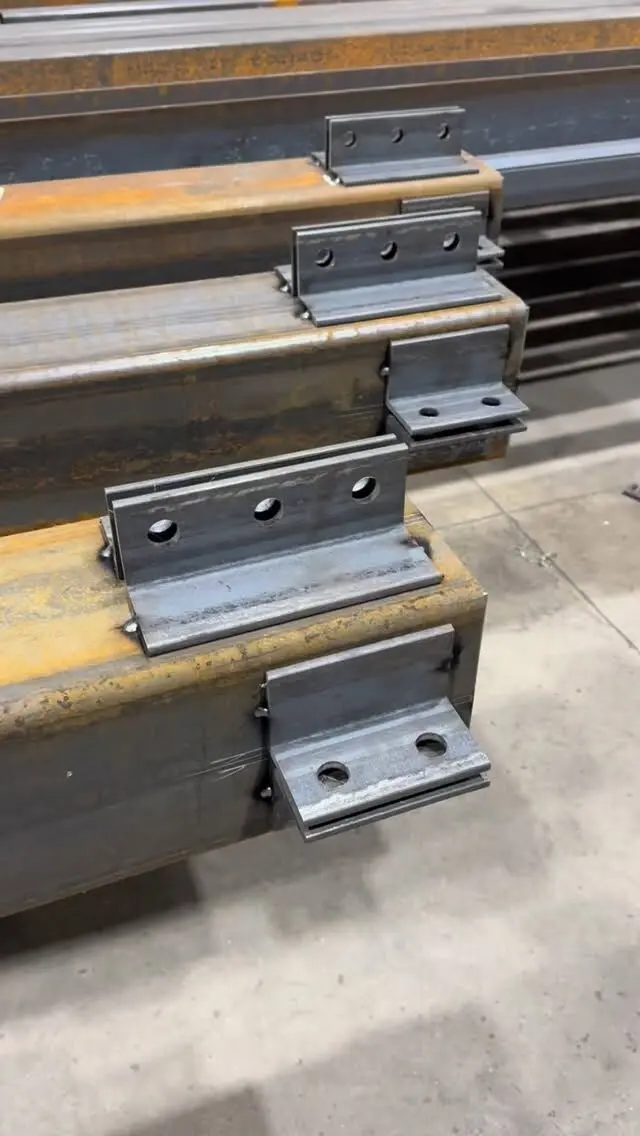
Steel beams connect to columns in two basic ways: with simple (shear) connections that carry the beam's reaction while letting its end rotate, or with moment connections that also pass bending into the column. Simple connections include shear tabs, double clip angles, shear end plates and seated connections. Moment connections include bolted flange plates, extended end plates and directly welded flanges. Which one goes where is a structural design decision made by the engineer, not a choice made on site.
This guide walks through each type, how it is made, where it is used, and what the fabricator needs on the drawings to build it. If you want the short bolted-versus-welded comparison and splice options instead, see bolted vs welded steel beam connections and splices.
Simple vs moment connections: the first decision
Every beam-to-column joint is designed to behave in one of three ways:
- Simple (shear) connections. The joint carries the vertical reaction from the beam but is flexible enough that the beam end can rotate a little. These are the default in most braced steel buildings, where lateral stability comes from bracing, shear walls or a concrete core.
- Moment (rigid) connections. The joint carries the reaction and the bending moment at the beam end, so the beam and column act as one frame. These are used where the frame itself resists wind and seismic loads, or where the designer wants to reduce beam depth or deflection.
- Partially restrained connections. Somewhere in between: the connection carries some moment and allows some rotation. They are less common on everyday Ontario work and need the engineer to account for the connection's stiffness in the analysis.
Because simple connections are lighter, faster to erect and easier to tolerate small fit-up differences, designers use them wherever the structure allows and save moment connections for the frames that need them.
Simple beam-to-column connections
Single plate (shear tab)
A plate is welded to the column flange (or web) in the shop. On site, the beam is lifted into place and its web is bolted to the plate. The shear tab is popular because the column leaves the shop with the plate already on, the beam needs only drilled holes in its web, and erection is quick. Slotted holes in the plate or beam web give a little room for adjustment.
Double clip angles
Two angles sit either side of the beam web, one leg attached to the web and the other to the column. Either leg can be bolted or welded, and a common arrangement is angles shop-welded or shop-bolted to the beam, then field-bolted to the column. Clip angles are flexible, forgiving and very familiar to erectors. They take more pieces and more bolts than a shear tab.
Shear end plate
A plate is welded across the end of the beam in the shop and then bolted to the column flange. It gives a neat, compact end detail. The trade-off is that the beam length has to be accurate, because there is little adjustment once the end plates are on: the beam either fits between its supports or it does not.
Seated connections
The beam sits on a seat angle (unstiffened seat) or on a seat with a stiffener under it (stiffened seat), which is attached to the column. A small top angle or side angle holds the beam upright. Seats make erection easy because the beam can be set down before anything is bolted. They are useful where access to the beam web is awkward, such as some connections to a column web.
Shear tee
A tee section, cut from a W-shape, is attached to the column with its stem bolted or welded to the beam web. It works much like a pair of clip angles in one piece and is used where the designer prefers a single fitting.
Moment connections
Bolted flange plates
Plates are welded to the column and bolted to the top and bottom beam flanges, with a shear tab or angles on the web carrying the vertical reaction. The flange plates carry the tension and compression from bending. This keeps field welding off the job, which matters on occupied sites, in cold weather and next to combustible materials.
Extended end plate
A thick plate is shop-welded to the beam end and extends above and below the beam. It is field-bolted to the column flange with high-strength bolts, often pretensioned. It is fast to erect, but it demands accurate fabrication, square beam ends and careful bolt installation, and the column flange usually has to be checked for the concentrated forces.
Directly welded flanges
The beam flanges are welded to the column with complete joint penetration groove welds, usually with a bolted or welded web connection that holds the beam during erection. These connections can be very compact, but much of the welding happens in the field. That means certified welders on site, weather protection, access, preheat where required and inspection. On structures designed to CSA S16, welding has to be done by companies certified by the Canadian Welding Bureau; see why hire a CWB-certified fabricator.
Column stiffeners and doubler plates
Bending at a moment connection pushes and pulls on the column flanges and squeezes the column web. Depending on the column size and the forces, the engineer may call for stiffeners (also called continuity plates) between the column flanges in line with the beam flanges, or a doubler plate on the column web. Whether they are needed is a design check, and they add real fabrication time, so it often pays for the designer to compare a heavier column with no stiffeners against a lighter column with them.
Framing to the column flange vs the column web
A W-shape column has two directions for beams to frame in:
- To the flange. The beam lands on a wide, flat face. Shear tabs, end plates, clip angles and moment connections all fit easily, and there is plenty of room for bolts and wrenches.
- To the web. The beam has to fit between the column flanges. For narrow beams this is straightforward. For wider beams, the beam flanges may need to be coped, or the shear tab extended out past the column flanges so the beam can be swung into place. Moment connections to the column web are possible but more complicated, which is one reason designers orient columns so the moment frames run in the strong direction.
Hollow structural section (HSS) columns are different again, because you cannot reach inside the tube to put a nut on a bolt. Those details are covered in W-beam to HSS column connections.
Beam on top of the column: cap plate connections
Not every beam frames into the side of a column. In many cases the beam simply sits on top:
- Houses and small buildings. A steel beam on a steel post is the standard basement detail. The post has a welded cap plate, and the beam is bolted or welded to it. The 2024 Ontario Building Code allows the top plate to be omitted where the column is attached to a steel beam another way, such as a bolted or welded connection. See HSS steel posts for basements and decks for the Part 9 rules on posts and plates.
- Commercial and industrial frames. Roof beams and girders often pass over columns with a cap plate, which makes continuous beams easy to set and allows the column to be erected before the beam arrives.
With a beam bearing on top, the engineer checks the beam web under the concentrated load. Bearing stiffeners welded between the beam flanges over the column are common where the web needs help. If two beams meet over the column, the cap plate has to be long enough to take both ends and their bolts.
How the connection types compare
| Connection | Type | Main advantages | Main drawbacks |
|---|---|---|---|
| Shear tab | Simple | Few pieces, fast erection, some adjustment | Limited for very deep or heavily loaded beams without extra checks |
| Double clip angles | Simple | Flexible, forgiving fit-up, familiar | More parts and bolts |
| Shear end plate | Simple | Clean, compact | Beam length must be accurate |
| Seated | Simple | Beam sets down easily, good where web access is poor | Seat projects below the beam |
| Shear tee | Simple | One fitting instead of two angles | Needs a tee cut from a W-shape |
| Bolted flange plates | Moment | No field welding | Many bolts, heavier plates |
| Extended end plate | Moment | Fast to bolt up | Tight fabrication tolerance, column flange checks |
| Welded flanges | Moment | Compact | Field welding, inspection, weather sensitivity |
| Beam over column cap plate | Usually simple | Simple to erect, suits continuous beams | Beam web may need bearing stiffeners |
What the fabricator needs on the drawings
Connections are where most fabrication time goes, so the drawings have to answer a few questions clearly:
- Which connections are simple and which are moment. Moment connections should be clearly marked on the framing plan.
- The forces. Beam reactions, moments and any axial forces at each connection, when the connection design is being done by an engineer working for the fabricator. On many Canadian projects the structural engineer designs the members and the connections are designed by the fabricator's engineer, using the forces on the drawings.
- Bolt and weld requirements. Bolt grade and diameter, whether joints are snug-tight, pretensioned or slip-critical, and the weld types.
- Typical details. Standard connection details save time on both the drawings and in the shop.
- Finishes and fire protection. Whether faying surfaces must be left unpainted for slip-critical joints, and any fireproofing that affects plates or clearances.
From there, the detailer produces shop drawings showing every plate, hole and weld. For more on that step, see shop drawings vs fabrication drawings.
Getting beams and columns made with their connections
We fabricate beams and columns with their connections, including base, cap and connection plates, cut, drilled and welded to the shop drawings we prepare in-house. Our shop welding is certified by the Canadian Welding Bureau, engineering services are available for projects that need them, and we supply and install structural steel from basement beams and posts to commercial framing. Send your structural drawings for a free take-off and quote, or see our fabrication and installation services.
Frequently asked questions
What are the main types of beam-to-column connections?
They fall into two families. Simple (shear) connections such as shear tabs, double clip angles, shear end plates and seats carry the beam's reaction but let the end rotate. Moment connections such as bolted flange plates, extended end plates and welded flanges also transfer bending into the column.
What is the most common steel beam to column connection?
In buildings framed with W-shapes, the single shear tab is one of the most common: a plate shop-welded to the column and bolted to the beam web on site. In houses, the most common joint is a beam sitting on top of a steel post with a welded cap plate.
What is the difference between a shear connection and a moment connection?
A shear connection transfers the vertical load from the beam but allows the beam end to rotate, so the frame needs bracing or walls for stability. A moment connection also transfers bending, so the beam and column work together as a rigid frame. Moment connections are heavier, cost more to make and need more careful erection.
Can a beam connect to the web of a column?
Yes. Beams frame into the column web as well as the flanges. Web connections often need the beam flanges coped or the connection extended so the beam fits between the column flanges, and the engineer checks the column web for the load.