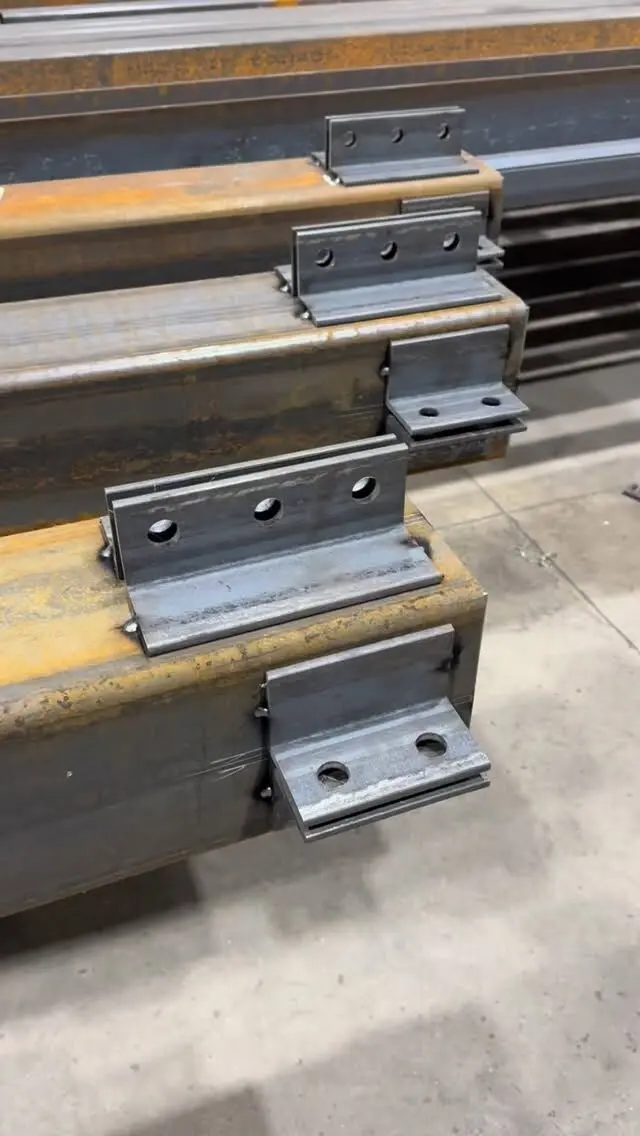
Structural steel connections can be sorted three ways: by where they are (beam-to-beam, beam-to-column, column splice, column base, bracing, and connections to concrete, masonry or wood), by how they behave (simple shear connections or moment connections), and by how they are fastened (bolted, welded, or both). On most Canadian jobs, plates and fittings are welded to the members in the shop and the pieces are bolted together on site. Every connection is designed for the forces it carries, by the structural engineer or by an engineer working for the fabricator.
This post is a map of the whole family: the joint types, the bolts and welds that make them, and the brackets and embeds that tie steel to everything else. For the beam-to-column details in depth, see types of steel beam-to-column connections.
Connections by location
| Joint | What it joins | Typical details |
|---|---|---|
| Beam-to-beam | A secondary beam to a girder | Shear tab, clip angles, end plate; beam flanges often coped to clear the girder |
| Beam-to-column | A beam to the side or top of a column | Shear tab, clip angles, end plate, seat, moment connection, cap plate |
| Column splice | Two lengths of column, end to end | Bolted flange and web plates, or welded splice |
| Beam splice | Two lengths of beam, end to end | Bolted flange and web plates, end plate splice, groove-welded splice |
| Column base | Column to footing, pier or wall | Welded base plate, anchor rods, levelling nuts or shims, grout |
| Bracing | Diagonal braces to beams and columns | Gusset plates, bolted or welded brace ends |
| Steel to concrete or masonry | Beams and angles to walls and slabs | Embed plates, post-installed anchors, bearing plates, ledger angles |
| Steel to wood | Wood framing to steel beams and posts | Bolted wood nailers, cap plates under wood beams, through-bolted ledgers |
A few of these have their own guides: column bases in column base plate design to CSA S16, beam and column splices in bolted vs welded steel beam connections and splices, and wood nailers in attaching a wood top plate to a steel beam.
Brackets, embeds and support angles
Not every connection is part of the main frame. Steel jobs are full of smaller connection pieces:
- Embed plates. Plates with headed studs or bars welded to the back, cast into concrete so steel can be welded or bolted to the surface later.
- Shelf and ledger angles. Angles bolted or welded along a beam or wall to carry joists, deck or masonry.
- Brackets and knee braces. Plate or angle brackets that carry a load out from a column or wall, such as a canopy beam or a crane rail.
- Bearing plates. Plates under a beam end where it sits on a concrete or masonry wall, spreading the load. The bearing length and plate size come from the design.
These are small pieces, but they are still structural. They need sizes, welds and anchors from the design, not from guesswork.
Connections by behaviour: simple vs moment
The same physical joint can be designed for different jobs:
- Simple (shear) connections carry the vertical reaction and let the beam end rotate. They are the most common type in braced buildings, where bracing, walls or a concrete core keep the building stable.
- Moment connections carry the reaction and the bending at the beam end, so the beam and column form a rigid frame that resists lateral loads. They are heavier and take more fabrication and erection effort.
- Partially restrained connections fall in between and are used less often.
Bracing connections are their own category: they mostly carry axial tension or compression along the brace, and the gusset plates and welds that attach them are designed for those forces, which can be large under wind or earthquake loads.
Bolts used in structural steel
The bolts in main structural connections are high-strength structural bolts, used with matching heavy hex nuts and hardened washers where required. In North America these are specified to ASTM F3125, which brought several older bolt standards into one specification:
| Bolt | What it is | Notes |
|---|---|---|
| F3125 Grade A325 | The everyday high-strength structural bolt | Most common grade in building connections |
| F3125 Grade A490 | Higher-strength structural bolt | Used where higher capacity per bolt is needed; more restrictions on use and coatings |
| F3125 Grade F1852 | Twist-off tension-control version of A325 | A spline end shears off when the bolt reaches pretension |
| F3125 Grade F2280 | Twist-off tension-control version of A490 | As above, at the higher strength level |
Some general points that apply to "types of bolt in steel detailing":
- Hardware-store bolts are not structural bolts. Common carbon steel bolts may appear on drawings for secondary items, but the main frame uses the grade the engineer specifies. Never substitute.
- Anchor rods are a separate product. The rods that hold a column base plate to a footing are specified by the engineer for that use, with their own grade, diameter, embedment and projection. They are not interchangeable with structural bolts.
- Hole type matters. Standard, oversized and slotted holes all appear in detailing. Oversized and slotted holes help with fit-up but can change the joint type and capacity, so they must match the design.
- Coatings matter. Plain, galvanized and other coated bolts are not always interchangeable, particularly for the higher-strength grade.
Bolted joint types: snug-tight, pretensioned and slip-critical
How a bolted joint is tightened is part of its design. The Research Council on Structural Connections (RCSC) specification, widely used in North America, recognises three joint types:
- Snug-tightened. The plies are pulled into firm contact, typically with a few impacts of an impact wrench or the full effort of an ironworker with a spud wrench. This is enough for most simple shear connections.
- Pretensioned. Each bolt is tightened to a specified minimum tension using an approved method: turn-of-nut, calibrated wrench, twist-off tension-control bolts or direct tension indicators. Used where joints see load reversal, vibration or certain tension loads.
- Slip-critical. Pretensioned, and also designed so friction between the faying surfaces carries the load without slip. The surface condition is part of the design, so paint, galvanizing or mill scale on the contact surfaces has to match what the engineer assumed.
In bearing-type joints (snug-tight or pretensioned), the bolt shanks bear against the sides of the holes once any slip has taken place. In slip-critical joints, the joint is designed to stay put. On Canadian projects, bolted connections are designed to CSA S16 and the joint type is shown on the drawings.
Welds used in steel connections
Structural welds come in a few basic forms:
- Fillet welds. Triangular welds placed in the corner between two pieces: a shear tab to a column, a stiffener to a web, a base plate to a column. By far the most common weld in building steel.
- Complete joint penetration (CJP) groove welds. The edge is prepared (bevelled) and the weld fills the full thickness of the joint, developing the strength of the connected part. Used in welded moment connections and full-strength splices.
- Partial joint penetration (PJP) groove welds. A groove weld that penetrates only part of the thickness. Used in some column splices and built-up members.
- Plug and slot welds. Welds made through a hole or slot in one piece into the piece below. Less common, used for specific details.
Welding on structures designed to CSA S16 has to be done by companies certified by the Canadian Welding Bureau, and welds follow CSA W59. Our overview of CSA W59 explains what that standard covers. Shop welding is preferred because the work can be positioned, controlled and inspected more easily.
Who designs the connections
Connection design responsibility varies by project, so check your contract and drawings:
- The structural engineer of record designs the structure, shows the members, and sets the connection requirements: forces, types, and any connections they detail themselves.
- On many commercial projects in Canada, the connections are designed by an engineer retained by the fabricator, using the forces from the structural drawings, and those designs are reviewed by the engineer of record.
- On houses and small renovations, the designer or engineer who sizes the beam and posts usually shows the bearing, the post-to-beam connection and the base detail on the permit drawings.
Either way, the shop drawings show every plate, hole, bolt and weld before anything is cut. Connections are designed and drawn, never improvised on site.
Getting connection steel fabricated
We fabricate beams, columns, posts, lintels and plates with their connections, including base, cap and connection plates, cut, drilled and welded to shop drawings we prepare in-house. Ask us about any other connection pieces your drawings show. Our shop welding is certified by the Canadian Welding Bureau, and engineering services are available for projects that need them. Send your drawings for a free take-off and quote, or see our fabrication, detailing and installation services.
Frequently asked questions
What are the types of structural steel connections?
By location: beam-to-beam, beam-to-column, column splices, column bases, bracing connections and connections to concrete, masonry or wood. By behaviour: simple (shear) or moment connections. By fastener: bolted, welded, or a mix, which is the most common.
What bolts are used in structural steel?
Main structural connections use high-strength structural bolts to ASTM F3125, mostly Grade A325 and Grade A490, plus the twist-off tension-control versions (Grades F1852 and F2280). The engineer specifies the grade, diameter and installation method.
What is a slip-critical connection?
A bolted joint designed so the connected plates do not slip relative to each other under service loads. The bolts are pretensioned and the friction between the contact surfaces carries the load, so the condition of those surfaces, including any paint, is controlled.
What is the difference between a fillet weld and a groove weld?
A fillet weld is a triangular weld placed in the corner where two pieces meet, and it is the most common structural weld. A groove weld is placed in a prepared gap between the pieces and can run through the full thickness (complete joint penetration) or part of it (partial joint penetration).