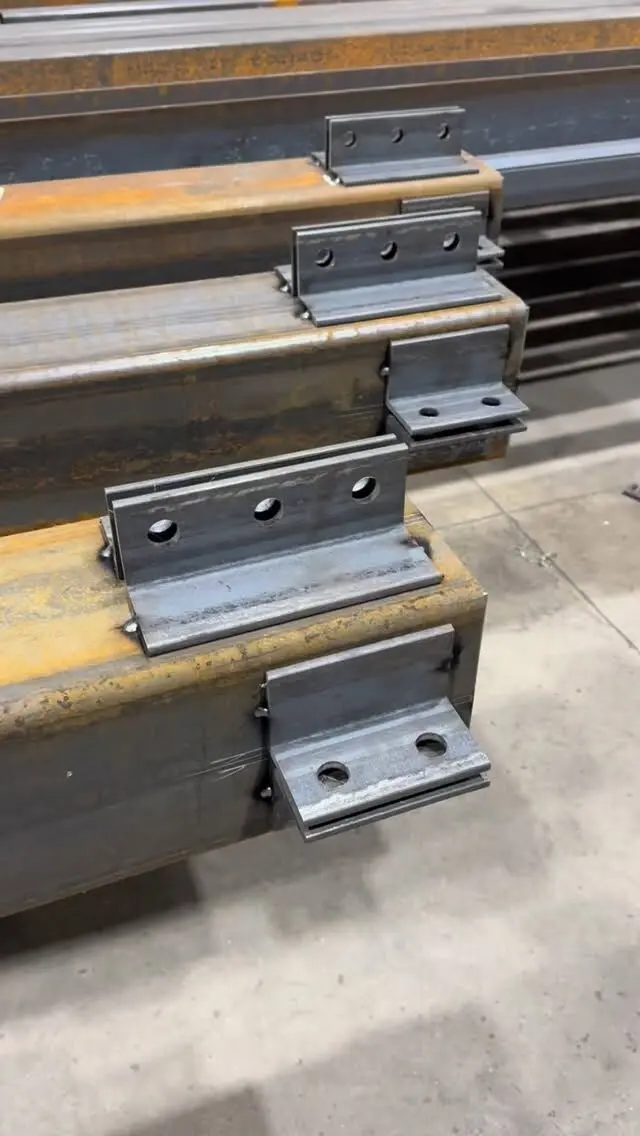
A W-beam connects to an HSS column in one of two ways: it sits on top of the column on a welded cap plate, or it frames into the side of the column through a plate welded to the tube wall (a shear tab) or passed right through it (a through-plate). The beam web is then bolted to that plate on site. What makes HSS different from a W-shape column is that you can't reach inside a closed tube to hold a nut, and the thin tube wall can bend locally under a concentrated load. Both have to be addressed by the connection design.
This guide covers the common details, where each one is used, and what to check before ordering. For choosing between W-shapes and HSS in the first place, see W-beam vs HSS.
Why HSS columns need their own details
HSS (hollow structural section) is popular for columns because it is stiff in both directions, compact, and easy to finish when exposed. Those same features change how beams attach:
- No access to the inside. With a W-shape column, you can bolt through the flange and get a wrench on both sides. With a closed tube, you can't. Connections are therefore usually made to plates shop-welded to the HSS, so all the bolting happens outside the tube.
- The wall is a plate supported only at its corners. A load pushed or pulled at the middle of an HSS face makes that face bend inward or outward, a bit like a drum skin. Thin walls and wide faces are more prone to this. The engineer checks the wall for local effects and may need a thicker wall, a smaller face, a through-plate or a different detail.
- Moment is harder to transfer. A beam flange pulling on the face of a tube does not deliver its force into the column as directly as it would to a W-shape flange backed by a web.
None of this makes HSS a poor column choice. It just means the connection is part of choosing the section. The broader family of HSS details is covered in HSS connections and framing.
Beam over HSS column: the cap plate detail
The most common W-beam to HSS connection, by far, is the beam over the column:
- A cap plate is welded to the top of the HSS in the shop, sealing the tube.
- The beam is set on the plate.
- The beam's bottom flange is bolted to the plate through matching holes, or welded to it, as the drawings show.
This is the standard detail under basement beams in houses, where a square HSS post carries a W200 or W250 beam. It is also used in commercial and industrial frames, especially where a beam runs continuously over several columns or where two beams meet over one column.
Things the designer and fabricator look after:
- Plate size and holes. The plate has to suit the beam flange width, edge distances for the bolts, and the layout if two beam ends land on it.
- Bearing under the beam web. A concentrated load from the column can crush or buckle the beam web. The engineer checks it, and bearing stiffeners (plates welded between the beam flanges over the column) are added where needed.
- Lateral restraint at the top. The column top and beam need to be held against rolling and racking. In houses, the 2024 Ontario Building Code requires columns to be securely fastened to the supported member and laterally supported. It also allows the top plate to be omitted where the column is attached to a steel beam in another way, such as a bolted or welded connection. Our post on HSS steel posts for basements and decks covers those rules.
- Fit. For a basement post, the post length is measured after the beam is in its final position and the structure is supported, allowing for the plates.
Beams framing into the side of an HSS column
When the column continues above the beam, or beams frame in at a floor level, the beam connects to the side of the tube.
Shear tab welded to the HSS wall
A single plate is welded to the face of the HSS in the shop, and the beam web is bolted to it on site. This is the simplest side connection and is common for lightly to moderately loaded beams. The engineer checks:
- the plate, bolts and welds, as for any shear tab;
- the HSS wall for the local effects of the plate pushing and pulling on it; and
- whether the wall is slender enough that a different detail is needed.
Through-plate
Slots are cut in opposite faces of the HSS, a single plate is passed right through the tube, and it is welded on both faces. The plate then delivers load to both walls instead of one, which reduces the local bending in the face. Through-plates also allow beams on opposite sides of the column to share one plate. They take more shop work (slotting and welding both faces), so they are used where the simple shear tab is not enough.
Single plate vs double angles on HSS
On a W-shape column, double clip angles are common. On an HSS column, they are less convenient: the angle legs against the tube would need to be welded, because bolting them to the tube would need nuts inside it. When angles are used, they are usually shop-welded to the HSS and field-bolted to the beam, or shop-attached to the beam and field-welded to the column. Most designers prefer the single plate on HSS for simplicity.
Seats and tees
A seat angle or stiffened seat welded to the HSS face can carry a beam set down on it, and a structural tee welded to the face works like a shear tab with a wider base on the wall. Both spread load differently across the face, and the choice is the engineer's.
Blind bolts
Proprietary blind bolts can be installed and tightened entirely from outside a closed section. They are used for some connections to existing HSS or architecturally exposed work. They are specialist products with their own design data, so they appear only where the engineer specifies them.
Moment connections to HSS columns
When a beam has to transfer bending into an HSS column, a plate on the wall is not enough. Common approaches include:
- Through-plates at the flange levels. Plates passing through the column at the top and bottom flanges of the beam, welded to both faces, so flange forces are delivered across the tube.
- External diaphragm or collar plates. Plates that wrap around the outside of the column at each flange level, collecting the flange force and spreading it around the tube.
- Heavier or filled columns. A thicker-walled tube, or a concrete-filled HSS, which changes how the face resists local forces.
All of these are specialised and engineered case by case. They add fabrication time and welding, which is why many designers keep HSS columns in braced frames with simple beam connections and use W-shape columns where moment frames are needed.
Practical points: sealing, water and finishing
A few details matter more with tubes than with open shapes:
- Seal the tube. Exterior HSS columns should be sealed with cap and base plates welded all around so water cannot get in, sit and freeze. Open tops collect rain.
- Vent and drain holes. Tubes that will be hot-dip galvanized need vent holes, and the location has to be shown on the shop drawings. We can prime or galvanize to suit the job.
- Welds on exposed steel. If the column is architecturally exposed, tell the fabricator so plate edges and welds are finished to suit.
- Base plates. The bottom of an HSS column needs its own detail. See column base plate design to CSA S16 for how base plates are sized.
Ordering W-beams with HSS columns
Beams and columns are best fabricated together so the plates, holes and lengths match. Send:
- The beam and column sizes and grades, for example W250x33 on HSS 102x102x6.4.
- The connection detail from the structural drawings: cap plate, shear tab, through-plate or moment connection.
- Elevations and lengths, or site measurements for renovation work.
- Base plate and anchor details.
- Interior or exterior, and the finish.
Beams and HSS columns fabricated together
We fabricate HSS columns and posts with base, cap and connection plates, and the W-beams that connect to them, to shop drawings we prepare in-house. Our shop welding is certified by the Canadian Welding Bureau, engineering services are available for projects that need them, and we supply and install basement beams and posts as well as commercial framing. Send your drawings or measurements for a free take-off and quote, or see our fabrication and installation services.
Frequently asked questions
How do you connect a W-beam to an HSS column?
Either the beam sits on top of the column on a welded cap plate, or it frames into the side of the column through a plate welded to the HSS wall (a shear tab) or passed right through the tube (a through-plate). The beam web is then bolted to the plate on site. The engineer chooses the detail and checks the HSS wall for the load.
Can you bolt directly to an HSS column?
Not with ordinary bolts, because you cannot reach inside a closed tube to hold the nut. That is why connections to HSS usually use plates shop-welded to the column. Special blind bolts that tighten from one side exist, but they are only used where the engineer specifies them.
What is a beam-over-column connection?
The beam runs over the top of the column and bears on a cap plate welded to the column, with bolts or welds holding the beam to the plate. It is the most common way to support a W-beam on an HSS post in houses and is also used for continuous beams in commercial frames.
Can an HSS column take a moment connection?
Yes, but it takes more than a plate on the wall. Moment connections to HSS columns use through-plates, external diaphragm or collar plates, or other engineered details that carry the flange forces around or through the tube. They are always designed by an engineer.