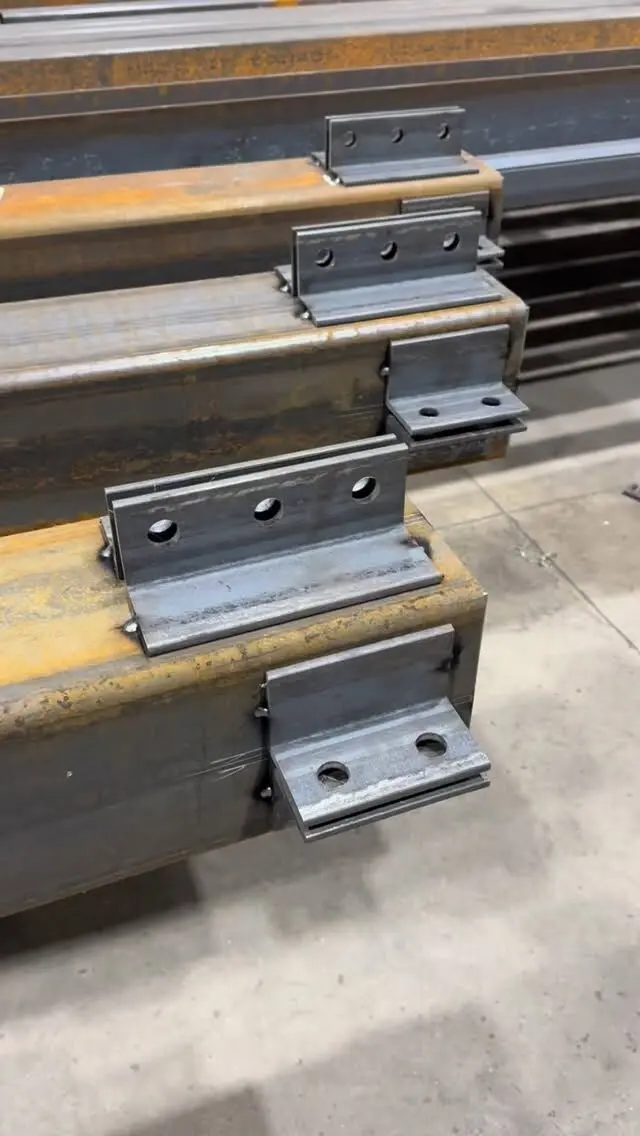
A base plate sits under a column and spreads its load into concrete through bearing and anchor rods. An end plate is welded across the end of a beam and bolts it to another steel member. A gusset plate is a flat connecting plate where several members meet, such as a brace landing at a beam-column joint or the web members of a truss. All three are just plate cut to shape, but they sit in different places, carry load in different ways and are designed with different checks.
Here's how the main connection plates compare, and what each needs on the drawings.
Connection plates at a glance
| Plate | Where it goes | What it connects | How it carries load | Typical attachment |
|---|---|---|---|---|
| Base plate | Bottom of a column or post | Steel to concrete or masonry | Bearing on grout and concrete; anchor rods for uplift, shear and moment | Welded to column; anchor rods to foundation |
| Cap plate | Top of a column | Column to the beam above | Bearing | Welded to column; bolted or welded to beam |
| End plate | Across the end of a beam or brace | Steel to steel | Bolts in shear, tension or both | Shop welded to the member, field bolted |
| Gusset plate | At brace, truss or bracing joints | Several members at one point | Tension and compression in the plate's plane | Welded or bolted to each member |
| Shear tab (fin plate) | On a column or girder | Beam web to support | Shear | Shop welded to the support, bolted to the beam web |
| Stiffener | Inside a beam or column | Reinforces the member itself | Local bearing, buckling or flange forces | Welded |
| Splice plate | Across a joint in a member | Two pieces of the same member | Continuity of force | Bolted or welded |
| Bearing plate | Under a beam end on concrete or masonry | Beam to support | Spreads the reaction | Loose or welded |
Base plates
A base plate is the connection between the steel frame and its foundation. The column is welded to the plate in the shop, and the plate is set on the footing or pier over cast-in anchor rods, levelled and then grouted so it bears fully on the concrete.
Base plates are designed for:
- Bearing of the column load on the concrete, which sets the plate area;
- Bending of the plate where it projects past the column, which sets its thickness;
- Anchor rods for uplift, shear and any moment, which set the number, diameter, embedment and edge distance.
Simple (pinned) bases for building columns usually have four rods; small basement posts have smaller plates with two or four fasteners. Fixed bases that resist moment have more rods, thicker plates and often stiffeners.
Base plates are covered in depth elsewhere: what a column base plate is, base plate size and thickness, base plate design to CSA S16 and base plate anchor bolts.
End plates
An end plate is a plate welded square across the end of a beam, so the beam can be bolted to a column, a girder or another beam. The welding happens in the shop where it's easy to control, and the site work is bolting.
There are two broad kinds:
- Shear end plates. A plate welded to the beam web (sometimes the full depth), bolted to the support. It carries the beam's end reaction and is treated as a simple connection.
- Moment end plates. A thicker plate welded to both flanges and the web. In a flush end plate the bolts stay within the beam depth; in an extended end plate the plate projects above and/or below the beam so bolts can sit outside the flanges. They transfer bending as well as shear, so the column flange may need stiffeners to take the flange forces.
End plates are fast to erect but unforgiving. Because the plate is welded square to the beam's end, the beam's length and the squareness of the cut have to be right in the shop. There's little room to adjust on site, so field measurements and tolerances matter. Bolted beam splices often use end plates too; see bolted vs welded beam connections and splices.
Gusset plates
A gusset plate is a flat plate at a joint where members meet at angles. You'll find gussets:
- where diagonal braces meet a beam-column joint or a beam at mid-span;
- at the panel points of steel trusses, joining chords and web members;
- at the ends of single-angle or double-angle bracing members;
- as small triangular plates stiffening a bracket or a corner.
Unlike a base plate, which works mostly in bearing and bending, a gusset carries tension and compression in its own plane. Its design checks include tension and block shear around the bolts or welds, yielding and buckling of the plate where the brace force spreads out, and the welds or bolts to each member. A compression brace can make the free edge of a gusset buckle if the plate is too thin or too long between connections.
Because gussets take their forces from bracing that resists wind and earthquake loads, their geometry is set by the connection designer and shown in detail on the shop drawings. Our post on structural steel bracing types covers the systems they belong to.
The other plates you'll see on shop drawings
- Cap plates close the top of a column and give the beam above something to bear on and bolt to. In houses, the 2024 Ontario Building Code (Sentence 9.17.3.2.(1)) requires steel columns to have end plates of at least 100 mm x 100 mm x 6.35 mm at each end, with the top plate extending the full width of a wooden beam. See lally column cap and base plates.
- Shear tabs (fin plates) are single plates welded to a column or girder that a beam web bolts to. They're the most common simple connection in building frames; types of steel beam-to-column connections compares them with clip angles and end plates.
- Stiffeners are plates welded inside a beam or column to stop the web crippling under a concentrated load or to take flange forces from a moment connection.
- Splice plates join two lengths of the same member, flange to flange and web to web.
- Fill and shim plates take up gaps between plies of a bolted joint or under bearings.
- Embed plates are cast into concrete with studs or anchors so steel can be welded to them later; see embed plates.
Specifying and ordering connection plates
Every plate needs the same information to be fabricated correctly:
- Size and thickness in millimetres, and the plate grade (commonly CSA G40.21 300W or 350W, as specified);
- Hole sizes and locations, dimensioned from a reference edge or the member;
- Weld type and size to the member, from the connection design;
- Finish: primed, galvanized, or left bare where it will be fireproofed or encased;
- Orientation and marks, so each plate goes on the right end of the right piece.
The engineer of record designs the connections or gives the forces for a delegated connection designer; the detailer turns them into shop drawings; the fabricator builds to those drawings. See types of structural steel connections for the bigger picture.
Plates fabricated with your steel
We cut and drill base plates, cap plates and connection plates to your details, and weld them to beams, columns and posts in our shop with CWB certified welding. Shop drawings are prepared in house, and we can prime or galvanize to suit. Send your structural drawings or a plate list and we'll prepare a take-off and quote at no charge.
Request a quote, or see our steel products, including plates, posts and beams.
Frequently asked questions
What is the difference between a base plate and an end plate?
A base plate sits under a column and spreads its load into concrete, where it is held by anchor rods. An end plate is welded across the end of a beam (or brace) and bolts to another steel member, such as a column flange, so it transfers load steel to steel.
What is the difference between a base plate and a gusset plate?
A base plate is a bearing plate between a column and a foundation. A gusset plate is a connecting plate in the steel frame where several members meet, such as a brace and a beam-column joint or the members of a truss, and it carries forces in its own plane.
What types of base plate connections are there?
The common ones are pinned base plates with two or four anchor rods for columns that carry axial and shear load, fixed or moment base plates with more rods and often stiffeners, and small post base plates for basement columns and railings. They may be set on grout or levelling nuts, and some are cast into embeds.
Who decides the size of a connection plate?
The engineer of record designs it or specifies the forces, and the connection designer or detailer shows it on the shop drawings. The fabricator cuts, drills and welds the plate to those drawings.