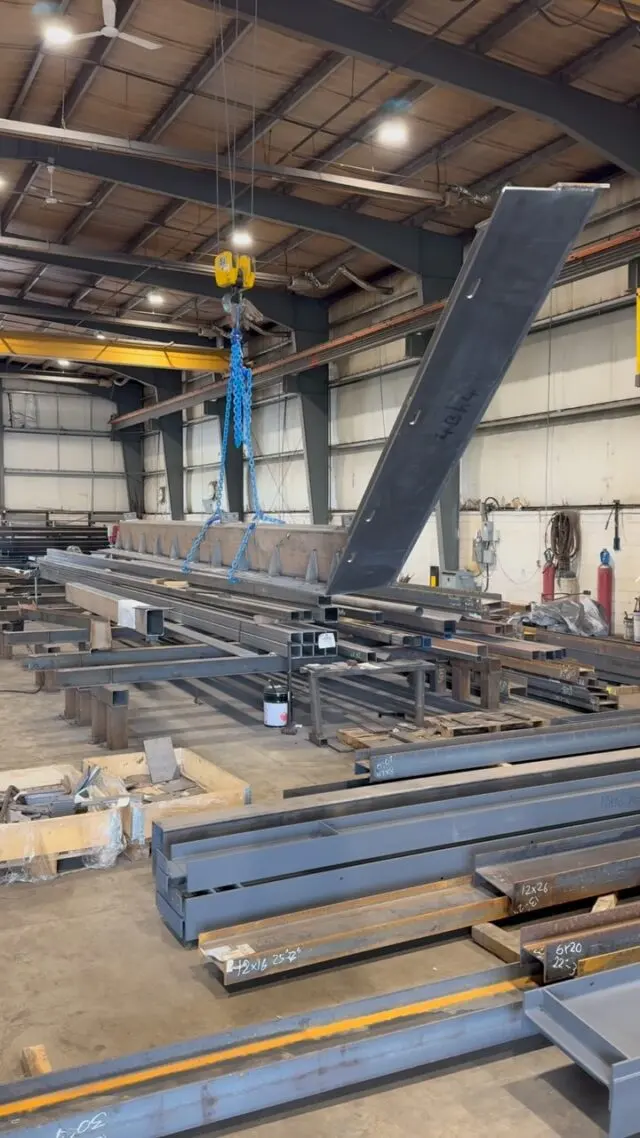
A structural steel fabricator takes beams, columns, tube, angle and plate from the mill or service centre and turns them into finished pieces that are ready to bolt or weld into a building: cut to length, drilled, fitted with plates, welded, coated and marked to match the drawings. Around that shop work, the fabricator also estimates the job, produces or manages the shop drawings, buys the steel, checks quality and delivers the pieces in the order the site needs them. Many fabricators also erect the steel.
This post explains the fabricator's role on a project from start to finish, and how it differs from the other companies involved. For the shop processes themselves, see what steel fabrication is.
Where the fabricator sits on a project
Several companies touch the steel between the mill and the finished building. The fabricator is in the middle.
| Who | What they do |
|---|---|
| Engineer of record | Designs the structure, sizes members, sets loads and typical connections, reviews shop drawings |
| Steel mill or tube producer | Rolls beams, channels, angles and plate; forms HSS from coil |
| Service centre or supplier | Stocks mill steel and sells it, often cut to length |
| Structural steel fabricator | Details, fabricates, coats, marks and delivers finished pieces |
| Erector | Lifts, plumbs, bolts and field welds the steel on site |
| General contractor or owner | Hires the fabricator, coordinates trades and schedule |
On a house or small commercial job, the same fabricator may also do the erection, which gives one point of responsibility from drawings to installed steel. On larger projects the erector is often a separate company. Our post on steel fabrication vs erection explains how those scopes divide.
The fabricator's job, stage by stage
1. Estimating and quoting
It starts with the drawings. The fabricator's estimator does a take-off: listing every member, plate, bolt and weld, then working out material, shop hours, coating, delivery and erection if included. The quote should say clearly what is included and what is by others.
2. Shop drawings and connection details
Design drawings say what is needed. The fabricator needs drawings that say exactly how to make each piece. The fabricator's detailers (in-house or contracted) prepare:
- Anchor bolt layouts so the concrete contractor can set bolts before the steel arrives.
- Erection drawings that show where every piece mark goes.
- Shop (assembly) drawings of each piece with its holes, plates and welds.
The engineer of record reviews these before fabrication. Where the contract delegates connection design to the fabricator, the fabricator's engineer designs those connections to the loads given by the engineer of record.
3. Buying and tracking material
The fabricator orders the shapes, plate and bolts in the grades specified, typically CSA G40.21 or equivalent ASTM grades for Canadian work. Mill test certificates are kept so the steel can be traced back to the mill if the specification or an inspector asks.
4. Fabrication in the shop
This is the core of the job:
- Cutting members to length and coping beam ends.
- Holemaking: drilling or punching bolt holes.
- Fitting: positioning base plates, cap plates, end plates, shear tabs, stiffeners and clips.
- Welding to approved procedures by qualified welders.
- Specialty work such as cambering beams so they finish level under load.
The full sequence is set out in the structural steel fabrication process, and the methods behind each step in types of steel fabrication processes.
5. Quality control
Before a piece leaves, it is checked against the shop drawings: dimensions, hole locations, plate positions and weld sizes, within the tolerances in CSA S16 and the project specification. Welds are inspected, and some are tested by an independent inspection company where the specification calls for it.
6. Coating and marking
Pieces are cleaned and primed, painted or galvanized as specified, with surfaces such as faying surfaces or fireproofed areas left bare where the drawings say so. Each piece is marked with its piece mark so the erector can match it to the erection drawings.
7. Delivery
Steel is loaded in the order it will be erected, so the crew is not digging through a pile for the next piece. On a residential job that might be a single beam and two posts on one truck, timed for the day the framer has temporary shoring in place. Large jobs are delivered in phases to suit the site schedule and laydown space.
8. Erection, if included
If the fabricator also installs, its crew sets the steel on the anchor bolts, plumbs and bolts it, and makes any field welds. If not, the erector takes over at the delivery point, and the fabricator stays on call for missing pieces or fit-up questions.
What a fabricator does not do
Knowing the limits avoids scope gaps:
- Design the building. Member sizes and loads come from the engineer of record.
- Approve its own shop drawings. The design team reviews them.
- Set anchor bolts or pour concrete. The fabricator usually supplies the bolts and layout; the concrete contractor sets them.
- Make site changes on its own authority. If something on site does not match, the fix goes through an RFI to the engineer.
- Supply other trades' items unless they are in the contract, such as metal deck, joists or miscellaneous metals.
Structural steel fabricator vs metal fabricator vs welder
These terms are used loosely, but they mean different things:
- Metal fabricator is the umbrella term. It covers sheet metal shops, machine shops, ornamental metal shops, tank builders and more.
- Structural steel fabricator is a metal fabricator that makes the load-carrying steel of buildings and structures, working to CSA S16 and the structural drawings. In Canada, structural fabricators that weld are certified by the Canadian Welding Bureau.
- Welder is a trade, and one of several in a fabrication shop. A fabricator employs welders, fitters, detailers, estimators and quality staff.
For homeowners, the practical point is this: a mobile welder can repair a gate, but a steel beam to replace a bearing wall should come from a structural fabricator working from an engineer's design, with certified welding and marked, checked pieces.
What a fabricator needs from you
To quote and build accurately, a fabricator needs:
- The structural drawings at the current issue, plus architectural drawings where dimensions come from them.
- The specification, or at least the general notes on coatings, grades and welding.
- Your scope: supply only, fabricate and deliver, or supply and install.
- Schedule and site access for delivery and erection.
Our post on choosing a structural steel fabricator in Ontario covers what to check before you hire one.
What we do at Procut
We fit, cut, weld, grind, mark and bundle structural steel to the shop drawings we prepare in-house, with CWB-certified shop welding, heat cambering where specified, and priming or galvanizing to suit. Orders are delivered across the GTA and Ontario, phased to your schedule, and we supply and install structural steel and rebar, from basement beams and posts to commercial projects. Engineering services are available for projects that need them.
Send us your drawings for a free take-off and quote, or see our services.
Frequently asked questions
What is a steel fabricator?
A steel fabricator is a company that takes steel shapes and plate from mills and service centres and turns them into finished, ready-to-install pieces, cut, drilled, fitted, welded, coated and marked to match the project drawings.
What is the difference between a steel fabricator and a steel supplier?
A supplier or service centre sells steel, usually cut to length. A fabricator works from the structural drawings to produce finished pieces with plates, holes, welds and markings, ready to erect.
Does a steel fabricator design the structure?
No. The engineer of record designs the structure and sizes the members. The fabricator prepares shop drawings that interpret the design, and may design connections where the contract delegates that to the fabricator's engineer.
What does a metal fabricator do?
Metal fabricator is the broader term. It covers shops that make anything from sheet metal enclosures and machine parts to railings and tanks. A structural steel fabricator is a metal fabricator that specializes in the load-carrying steel of buildings and structures.
Does a steel fabricator install the steel?
Some do and some do not. Many Ontario fabricators supply, fabricate and install, while others hand the pieces to a separate erector. Confirm which you are getting before you sign.