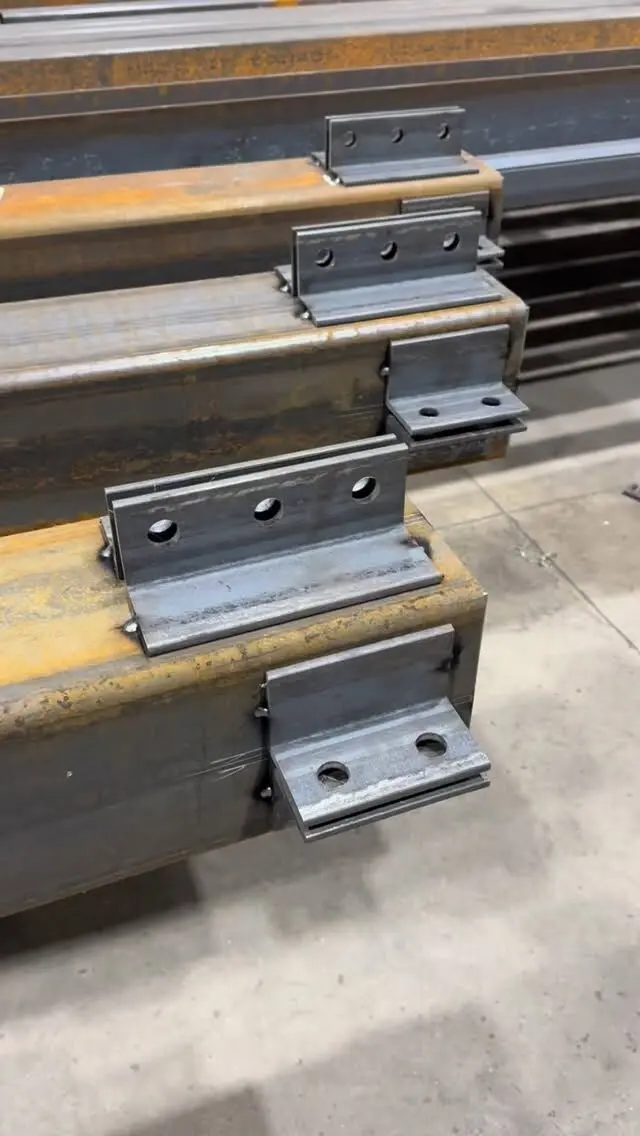
Miscellaneous metal fabrication covers the fabricated steel items on a project that are not part of the main structural frame: stairs, railings, ladders, loose lintels, embed plates, bollards, support angles, frames and equipment supports. These pieces are small compared with the frame, but there are a lot of them, each is custom, and many have to be in place before other trades can start. Expect a separate quote, separate shop drawings, and more coordination per tonne than any other steel on the job. Here is what that looks like in practice.
What counts as miscellaneous metals
The list varies from project to project, but a typical miscellaneous steel scope includes:
- Stairs and landings, including pan stairs, grating stairs and steel stringers for feature stairs
- Railings, guards and handrails
- Fixed ladders, ship ladders, roof hatch ladders and safety cages
- Loose lintels for masonry openings (lintels not attached to the structural frame)
- Embed plates, anchor bolts and cast-in items set in concrete for other connections
- Shelf angles and relieving angles for masonry and cladding
- Bollards and pipe guards
- Frames for overhead doors, roof openings and floor openings
- Equipment supports and hangers for mechanical and electrical units
- Gates, fences and screens
- Checker plate and grating covers for trenches and pits
- Corner guards, edge angles and wheel guards
On residential work, "misc steel" usually means the custom pieces around the house: a steel stair, a railing, a gate, a lintel or a bracket.
Structural steel vs miscellaneous steel
The split matters because it decides who supplies what, how it is drawn and how it is priced.
| Structural steel | Miscellaneous steel | |
|---|---|---|
| What it is | The primary frame: beams, columns, bracing, connections | Secondary items that support, protect, provide access or finish |
| Typical specification section (MasterFormat) | Section 05 12 00 (structural steel) | Sections in the 05 50 00 range (metal fabrications), such as 05 52 00 for metal railings |
| How it is priced | Largely by tonnage and connection count | Item by item, by layout and fabrication time |
| Drawings | Erection drawings plus piece drawings | Many small details, often one sheet per item type |
| Installation | Erected with the frame | Often installed by a different crew, at different times through the job |
On a commercial project the specification and drawings decide which items fall in which package. Read both carefully, because items like loose lintels, embeds and roof frames can sit in either depending on the project.
Who designs misc steel
On architect-led projects, the drawings show where each item goes and what it must do: a guard height, a lintel span, a ladder location. How much detail they show varies:
- Fully designed items have member sizes and connections on the structural drawings. The fabricator details them.
- Delegated design items, often stairs, guards, ladders and some supports, are specified by performance. The fabricator's engineer designs them, and the specification may require drawings and calculations sealed by a professional engineer licensed in Ontario.
- Residential items are often built from the homeowner's designer's drawing or a sketch, with engineering added where the item is structural or the building department asks for it.
Ask early which items are delegated, because engineering affects both price and schedule. For the drawing side, see steel shop drawings: what drives the cost and do shop drawings need an engineer's stamp in Ontario.
How a misc metals job runs
- Take-off and quote. The estimator lists every item from the drawings and specifications, with quantities, sizes, finish and installation.
- Award and clarifications. Scope gaps are settled now, not on site (see below).
- Shop drawings and submittals. Items are detailed and sent for review, usually in groups so early items like embeds go first.
- Field measuring. Stairs, railings and anything fitted between built surfaces are measured once those surfaces exist.
- Fabrication and finish. Cutting, fitting, welding and grinding, then primer, paint, powder coat or galvanizing.
- Phased delivery. Items go to site when each trade needs them: embeds before the pour, lintels with the masonry, stairs once the shafts are ready, railings near the end.
- Installation and touch-up.
The timing is the hard part. Embed plates and anchor bolts are needed well before anything attaches to them, and a late embed means drilled anchors or a field fix later. Build the misc steel schedule around the concrete and masonry schedules, not around the frame.
Scope gaps to watch for
Most misc metals disputes come from items that fall between trades. Settle these in writing at the quote stage:
- Embeds: who supplies them, and who sets them in the forms
- Loose lintels: misc steel, masonry contractor or structural steel?
- Supply only vs supply and install: for each item, not just the package
- Galvanizing and coatings: which items, and whether field touch-up is included
- Field welding and fire watch where required
- Anchors and core drilling into concrete and masonry
- Engineering: which items need sealed drawings
- Field measuring: who measures and when
- Hoisting: whether the site crane or hoist is available, or the supplier brings equipment
- Temporary guards: who supplies them until permanent railings go in
A misc steel quotation that lists items, quantities and these responsibilities is much easier to compare than a lump sum. For the factors behind custom fabrication pricing, see custom steel fabrication cost.
Materials and finishes
Miscellaneous items use the same steel as structural work, in smaller sizes: angles, channels, flat bar, plate, HSS and pipe. Common finishes:
- Shop primer for interior items that will be painted on site
- Paint or powder coat for visible interior items
- Hot-dip galvanizing for exterior items, wet areas and anything cast into or against concrete outdoors
- Stainless steel or aluminum for some railings and special items, quoted separately
Grade and size come from the drawings. Small sections such as light angles and flat bar are widely stocked in imperial sizes, so a metric size on a drawing may be supplied as the nearest imperial equivalent; the designer should accept any substitution. Where items are cast into concrete or masonry, plan the finish with the other trade: galvanized embeds and anchors are common outdoors, and coatings near areas that will be welded on site have to be planned so the weld can be made properly and the coating repaired afterward.
Welding quality matters on items people stand on or hold. Ask whether the fabricator's shop is certified by the Canadian Welding Bureau; see why hire a CWB-certified fabricator.
Choosing a misc steel fabricator
Look for the same things you would for structural work: certified welding, in-house detailing, a realistic schedule and clear scope. A shop that does both structural and miscellaneous steel can supply related items together, such as a steel stair and the landing framing it bears on, which removes one interface. Our guides on choosing a structural steel fabricator and choosing a steel stair fabricator cover the questions to ask.
Miscellaneous steel from Procut
Beyond primary framing, we fabricate miscellaneous steel including custom stairs, railings, gates, ladders and light supports, along with lintels, plates, posts and channels. Our shop welding is CWB certified, shop drawings are prepared in house, engineering services are available, and phased deliveries can be matched to your schedule across the GTA and Ontario. Take-offs and quotes are free.
Send your drawings and specifications for a misc steel quote, or see our services and steel products.
Frequently asked questions
What is considered miscellaneous metals in construction?
Miscellaneous metals are the fabricated steel items that are not part of the main structural frame: stairs, railings, ladders, loose lintels, embed plates, bollards, frames for openings, support angles, equipment supports, gates and similar pieces. On specified projects they are usually written into their own specification sections, separate from structural steel.
What is the difference between structural steel and miscellaneous steel?
Structural steel is the primary frame that carries the building's loads: beams, columns, bracing and their connections. Miscellaneous steel is the long list of secondary items that support, protect or provide access. The two are often priced and drawn separately, even when one fabricator supplies both.
Who designs miscellaneous metal items?
The architect and engineer show where items go and what they must do. For some items, such as stairs and guards, specifications often delegate the detailed design to the fabricator, with drawings sealed by a professional engineer. Either way, the fabricator's shop drawings are reviewed before fabrication.
Why are miscellaneous metals hard to price?
There are many small, different pieces, each with its own layout, connections and finish. A misc metals package can have dozens of item types, and the time goes into detailing, fitting and coordination rather than tonnes of steel.