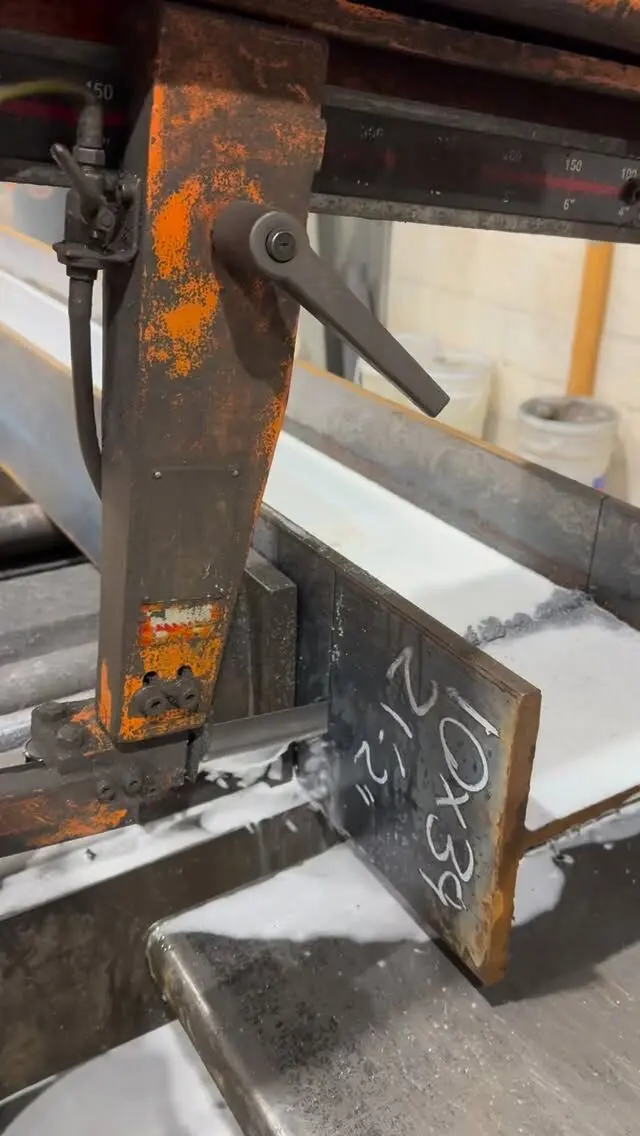
You can buy a steel lintel from three kinds of places in Ontario: building and masonry supply yards (stock angle sizes), steel service centres (raw angle cut to length) and structural steel fabricators (lintels cut, drilled, welded and finished to your drawings). If your opening needs a plain angle in a common size, a supply yard may have it on the shelf. If it needs paired angles, bolt holes, welded plates, a beam lintel or a specific coating, order it from a fabricator.
Where to buy a steel lintel
Each source suits a different kind of job. The right one depends on how much work the lintel needs before it goes in the wall.
| Source | What you get | Best for |
|---|---|---|
| Building or masonry supply yard | Common angle sizes, often in set lengths | A single veneer opening using a standard angle |
| Steel service centre | Raw angle, plate and beams, usually cut to length | Contractors who will drill, weld and paint the steel themselves |
| Structural steel fabricator | Lintels cut, punched or drilled, welded, finished and marked to drawings | Custom sizes, paired or bolted angles, beam lintels, multiple openings, engineered details |
A fabricator works from your drawings or the engineer's details rather than from a shelf, so the lintel arrives ready to set. That matters most on renovation work, where openings are rarely a standard width and the lintel often has to suit an existing wall.
When a stock angle is enough and when you need a custom lintel
Most window and door openings in brick veneer houses use a single steel angle. The 2024 Ontario Building Code has a table of angle sizes and maximum spans for lintels supporting masonry veneer, and if your opening falls inside it, a stock angle cut to the right length may be all you need. We cover how those tables work in our guide to steel lintel sizes under the Ontario Building Code.
You are into custom territory when any of these apply:
- Solid masonry walls. Older double-wythe brick walls carry floor and roof loads, and the code table for them calls for interior angles as well as the exterior angle, bolted together on longer spans.
- Wide openings. Garage doors, patio doors and new openings in renovations can exceed what a single angle can span.
- Concentrated loads. A beam, girder truss or post landing above the opening means the lintel has to be designed for that load.
- Built-up shapes. Angles welded to a plate, angles hung from a beam, or a wide-flange beam with a plate welded to the flange to carry veneer.
- Odd geometry. Bay windows, corner openings and openings in stone need pieces that suit the layout.
- Engineered details. When an engineer has specified the lintel, it should be supplied exactly as drawn, including holes, welds and finish.
Our shop cuts angle lintels to length and punches, drills or welds them as needed, with shop welding certified by the Canadian Welding Bureau. If you are not sure whether your opening needs a custom piece, send the drawings or a description and we will tell you what we see.
What to send when you order a lintel
A complete order avoids the most common problem with lintels: a piece that arrives too short, in the wrong size, or without the holes the detail calls for. Have this ready:
- Clear opening width for each opening, measured between the masonry jambs.
- Bearing length at each end. Lintels sized from the Ontario Building Code tables need at least 150 mm of bearing at each end, on masonry, concrete or steel. Your designer may call for more.
- Overall length of each piece, which is the opening width plus the bearing at both ends.
- Section size, written as vertical leg × horizontal leg × thickness in millimetres (for example, L102 × 89 × 7.9). This should come from the drawings, the code table or the engineer.
- Wall type, such as brick veneer over wood frame, solid brick, block, or stone, plus the veneer thickness.
- Holes, bolts and welds shown on the detail, for example paired angles bolted back to back or a lintel fastened to a beam.
- Finish: prime paint, galvanized, or galvanized and painted.
- Quantity and marks, so each lintel is tagged to its opening on the drawings.
- Delivery address, site access and timing.
For a whole house or a multi-unit building, a window schedule or elevation drawings with opening sizes let us prepare the full lintel list in one take-off rather than piece by piece.
How much does a steel lintel weigh?
Lintel weight matters for handling on site (how many people or what equipment it takes to lift the piece into the wall) and for delivery. Weight depends on the angle's legs and thickness. The figures below are calculated from the nominal leg sizes and the density of steel, so treat them as close approximations. The mill's published section data governs.
| Angle size (mm) | Imperial equivalent | Approx. weight (kg/m) | Approx. weight (lb/ft) |
|---|---|---|---|
| L89 × 76 × 6.4 | 3-1/2 × 3 × 1/4 in | 8.0 | 5.4 |
| L89 × 89 × 6.4 | 3-1/2 × 3-1/2 × 1/4 in | 8.6 | 5.8 |
| L102 × 89 × 6.4 | 4 × 3-1/2 × 1/4 in | 9.3 | 6.2 |
| L102 × 89 × 7.9 | 4 × 3-1/2 × 5/16 in | 11.4 | 7.7 |
| L127 × 89 × 7.9 | 5 × 3-1/2 × 5/16 in | 12.9 | 8.7 |
| L127 × 89 × 11 | 5 × 3-1/2 × 7/16 in | 17.7 | 11.9 |
| L152 × 89 × 11 | 6 × 3-1/2 × 7/16 in | 19.9 | 13.4 |
| L152 × 102 × 13 | 6 × 4 × 1/2 in | 24.6 | 16.5 |
| L178 × 102 × 13 | 7 × 4 × 1/2 in | 27.2 | 18.3 |
To estimate a piece, multiply the weight per metre by the overall length. A 2.4 m lintel in L102 × 89 × 7.9 is about 2.4 × 11.4 = 27 kg. Paired angles, welded plates and beam lintels add up quickly, so ask us for the shipping weight of a fabricated piece when you order.
Finish: primed or galvanized?
The Ontario Building Code requires steel angle lintels supporting masonry to be prime painted or otherwise protected from corrosion. That is a minimum. The choice between primer and hot-dip galvanizing usually comes down to how wet the lintel will get over its life and how hard it would be to replace.
- Shop primer is common for lintels that will sit behind properly flashed masonry and stay dry.
- Galvanizing gives longer protection where water reaches the steel, such as exterior openings in older walls without good flashing, openings near grade, or anywhere you would rather not open the wall again.
- Galvanized and painted is used where the steel is exposed to view or the specification calls for a paint colour.
Galvanizing is a separate process applied after fabrication, so it adds a step to the schedule. Welding and drilling should be finished before the steel is galvanized. If you want galvanized lintels, say so when you request the quote so the timing is planned in from the start. Our article on replacing a rusted steel lintel shows what happens to the wall when that protection fails.
Lead times and planning
Lead time for a lintel depends on whether the section is in stock, how much fabrication it needs, and whether it needs galvanizing. A plain angle cut to length is a different job from a set of bolted, galvanized lintels for a full building. We don't publish fixed lead times because they change with the order. Ask us when you request pricing and we will give you a date for your job.
A few habits keep lintels from holding up a project:
- Order early on new builds. Masons need lintels on site before they reach window head height.
- Confirm opening sizes on site for renovations. Existing openings are rarely the size on old drawings.
- Group openings into one order so pieces arrive together, tagged by opening.
- Have the design settled first. If the opening needs an engineer, get the lintel specified before ordering. Our article on how a steel lintel is installed in an existing brick wall covers who does what on a retrofit.
Ordering custom lintels from Procut
We fabricate steel lintels at our shop in Erin and deliver across the GTA and Ontario, alongside beams, posts and plates for the same job. Send your drawings, window schedule or opening sizes with the wall type and finish you want, and we will prepare a take-off and quote. Engineering services are available for projects that need them.
Request a lintel quote, or see the steel products we supply, including beams, posts, plates and channels for the rest of your project. For how lintel pricing is built, see what drives steel lintel cost.
Frequently asked questions
Where can I buy a steel lintel in Ontario?
Building and masonry supply yards carry common angle sizes, steel service centres sell angle cut to length, and structural steel fabricators supply lintels cut, drilled, welded and coated to your drawings. For anything beyond a plain angle, a fabricator is the simplest route.
How much does a steel lintel weigh?
It depends on the angle size. A light 89 × 89 × 6.4 mm angle is roughly 8.6 kg per metre, while a 152 × 102 × 13 mm angle is closer to 25 kg per metre. Multiply the weight per metre by the overall length to get the weight of the piece.
How long should I order a steel lintel?
Order the clear width of the opening plus the bearing at both ends. The 2024 Ontario Building Code requires at least 150 mm of bearing at each end for lintels sized from its tables, so a lintel is always at least 300 mm longer than the opening.
Should a steel lintel be galvanized?
The Ontario Building Code requires steel angle lintels supporting masonry to be prime painted or otherwise protected from corrosion. Galvanizing is a common choice where the lintel will see moisture, but your designer or the drawings should set the finish.