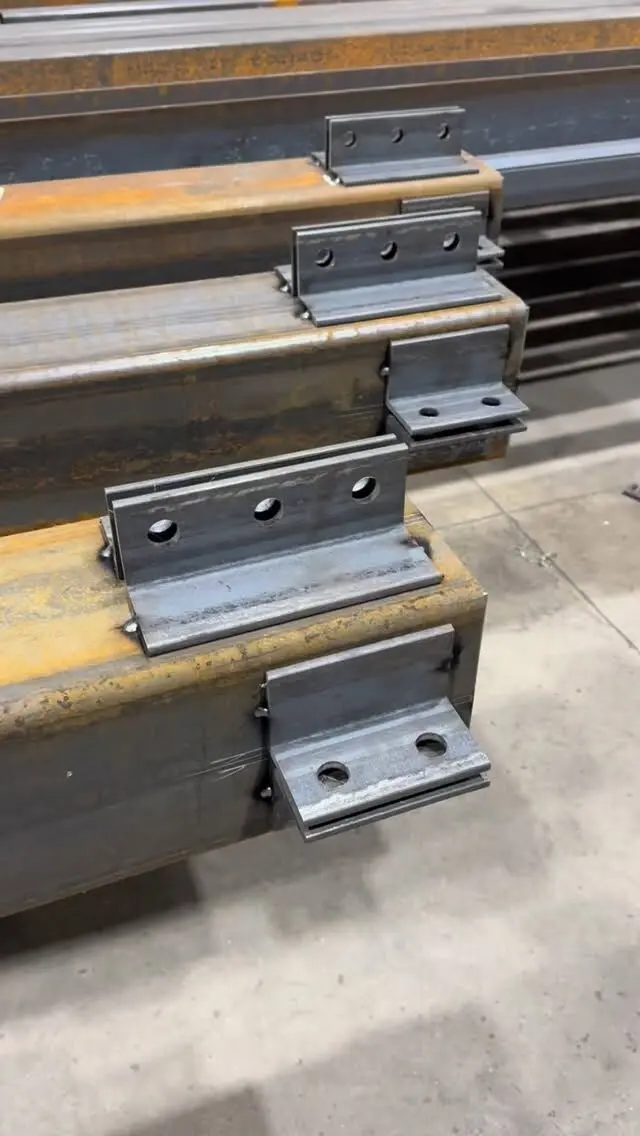
W8x18, W10 and W12 beams are priced mainly by weight, so the cost of the steel follows the second number in the name: pounds per foot. A W8x18 has 18 lb of steel per foot, a W10x33 has 33 lb, and a W12x40 has 40 lb. Fabrication, finish, delivery and installation are added on top, and for short beams those items can be a larger share of the bill than the steel. In Canada these sizes are often written in metric: a W8x18 is a W200x27.
We don't publish prices because steel moves with the market and every beam is fabricated differently. This guide gives you the numbers that drive the price for each common size, and shows why the lightest beam that works isn't always the shallowest.
Common W8, W10 and W12 sizes with metric equivalents
Each imperial size below is the same physical beam as its metric twin. Dimensions and masses are from the CISC section tables, cross-checked against the AISC Shapes Database metric values.
| Imperial | Metric | Depth | Flange width | Mass | Steel in a 20 ft length |
|---|---|---|---|---|---|
| W8x18 | W200x27 | 207 mm | 133 mm | 26.6 kg/m | 360 lb (162 kg) |
| W8x21 | W200x31 | 210 mm | 134 mm | 31.2 kg/m | 420 lb (190 kg) |
| W8x31 | W200x46 | 203 mm | 203 mm | 46.2 kg/m | 620 lb (282 kg) |
| W10x26 | W250x39 | 262 mm | 147 mm | 38.5 kg/m | 520 lb (235 kg) |
| W10x33 | W250x49 | 247 mm | 202 mm | 49.1 kg/m | 660 lb (299 kg) |
| W12x35 | W310x52 | 317 mm | 167 mm | 52.2 kg/m | 700 lb (318 kg) |
| W12x40 | W310x60 | 303 mm | 203 mm | 59.7 kg/m | 800 lb (364 kg) |
The 20 ft weight is a useful benchmark because 20 ft is a common stock length. For other lengths, multiply the weight per foot by the length. Our Canadian steel beam sizes chart lists more sections, and how to read steel beam sizes explains why the metric number isn't a straight conversion.
How each size is priced
The material share of a W-beam price is close to proportional to its weight. On the same day, from the same supplier, a W8x31 carries 31 lb of steel per foot against 18 lb for a W8x18, so its raw material cost is higher in roughly that ratio. Everything else is priced by the work involved:
- Cutting to length. One cut per end on a simple beam; more for notches, copes or angled ends.
- Holes. Bolt holes for connections, or holes for fastening a wood plate to the top flange.
- Plates. End plates, cap and base plates for posts, bearing plates, and stiffeners where loads come in.
- Welding. Plates and connections welded in the shop under certified procedures.
- Finish. Mill finish, primer, or a paint system for exposed steel.
- Delivery and installation. Set by length, weight and site access, not by section name.
So two beams of the same weight can have very different prices if one has a pair of simple bearing ends and the other has moment connections and a painted finish. Our guide to steel beam prices in Canada breaks these items down further.
Deeper is usually more efficient
Because the price follows weight, the cheapest beam for a job is usually the lightest section that works, and that is often a deeper one. A beam's stiffness in bending depends heavily on its depth. Compare the strong-axis moment of inertia (a measure of bending stiffness) for these sizes:
| Beam | Mass | Moment of inertia, Ix | Section modulus, Sx |
|---|---|---|---|
| W200x27 (W8x18) | 26.6 kg/m | 25.9 x 10⁶ mm⁴ | 250 x 10³ mm³ |
| W200x31 (W8x21) | 31.2 kg/m | 31.4 x 10⁶ mm⁴ | 290 x 10³ mm³ |
| W200x46 (W8x31) | 46.2 kg/m | 45.5 x 10⁶ mm⁴ | 448 x 10³ mm³ |
| W250x39 (W10x26) | 38.5 kg/m | 60.1 x 10⁶ mm⁴ | 459 x 10³ mm³ |
| W250x49 (W10x33) | 49.1 kg/m | 70.7 x 10⁶ mm⁴ | 572 x 10³ mm³ |
| W310x52 (W12x35) | 52.2 kg/m | 119 x 10⁶ mm⁴ | 748 x 10³ mm³ |
| W310x60 (W12x40) | 59.7 kg/m | 129 x 10⁶ mm⁴ | 849 x 10³ mm³ |
Two things stand out:
- A W10x26 is lighter than a W8x31 and stiffer. It has less steel per foot but a higher Ix and section modulus. Where the extra 60 mm or so of depth fits, it is often the more economical beam.
- A W12x35 and a W10x33 weigh about the same, but the W12x35 is much stiffer. If the ceiling height allows the deeper beam, more stiffness comes almost free.
These figures are for comparison only. The actual choice depends on the loads, the span, deflection limits, lateral support, how the beam bears at each end, and how deep the beam is allowed to be. That design work belongs to an engineer or qualified designer.
Why someone picks the heavier, shallower beam
If deeper is more efficient, why do W8x31 and W10x33 beams get specified at all? Usually for one of these reasons:
- Headroom. In basements and flush floor beams, the depth is fixed by the ceiling or the joists. A wide, heavy W8 or W10 may be the only way to carry the load within that depth.
- Flange width. The 203 mm flange of a W8x31, W10x33 or W12x40 gives a wider seat for joists, a wood plate or masonry, and better bearing on a post or wall.
- Columns. The square-ish W8x31 and W10x33 profiles are common as columns, where buckling about both axes matters more than depth.
- Matching existing steel in an addition or renovation.
So the right comparison isn't "W8 vs W10 vs W12" but "which section meets the design within the space available, at the lowest weight." Our article on steel beam span tables for Ontario homes shows how beams are chosen for typical house spans.
Availability and lead time
Light and medium W-shapes in the W8 to W12 range are generally easy to source, and the sizes on this page are common in residential and light commercial work. Availability still varies by supplier and by month, and a specific length or a less common weight in the same depth group may take longer to source. Ask about lead times for your sizes when you request a quote rather than assuming any particular section is on the rack.
What to send for a W-beam quote
To price a W8, W10 or W12 beam accurately, send:
- The section (metric or imperial, either is fine) and the steel grade if specified
- Cut length, or the field-measured length including bearing at each end
- Quantity of each size
- Fabrication: end plates, holes, cap or base plates, stiffeners, camber
- Finish requirements
- Site address, delivery timing and access notes
- Whether you also need posts, or supply and installation
If the beam hasn't been designed yet, start with the designer: a size picked from a table without checking loads is a guess, and a wrong guess costs more than the beam.
Get W-beam pricing from Procut
We supply wide-flange beams cut to length or fully fabricated, with plates, holes and connections ready for install, CWB certified shop welding and in-house shop drawings. Engineering services are available for projects that need them. Send your beam list or drawings and we'll quote the beams, posts and plates together, with delivery across the GTA and Ontario. See our steel products for everything we fabricate.
Frequently asked questions
How much does a W8x18 steel beam cost?
A W8x18 (W200x27 in metric) has 18 lb of steel per foot, so its material cost follows its length and the current steel price. Cutting, holes, plates, finish, delivery and installation are added on top. Send the length and any fabrication details for a firm price.
What is the metric equivalent of a W8x18?
A W8x18 is the same rolled section as a W200x27. It is about 207 mm deep with a 133 mm flange and weighs about 26.6 kg per metre.
Is a W10 beam more expensive than a W8?
Not necessarily. Beam price follows weight, not depth. A W10x26 weighs less per foot than a W8x31, so it has less steel in it, and it is also stiffer in bending. Depth limits and connection details decide which one suits the job.
Why is a W12x40 shallower than a W12x35?
The W12x40 belongs to a wider-flange series. It is about 303 mm deep with a 203 mm flange, while the W12x35 is about 317 mm deep with a 167 mm flange. The nominal 12 is a family name, not the exact depth.
Can I substitute a different beam size to save money?
Only with the engineer's or designer's approval. A lighter or shallower beam may not carry the load or may deflect too much. Ask the designer whether an alternative section works before you order.