Canadian steel beams are mostly W-shapes (wide-flange beams), designated by nominal depth in millimetres and mass in kilograms per metre: a W200x27 is about 207 mm deep and weighs 26.6 kg/m. Each metric W-shape is the same physical beam as a US imperial size (W200x27 is W8x18). The chart below covers the sizes most often used in houses, renovations and light commercial buildings, with dimensions taken from the CISC section tables.
Common W-shape sizes: metric chart with imperial equivalents
Dimensions are from the Canadian Institute of Steel Construction (CISC) structural section tables, cross-checked against the metric columns of the AISC Shapes Database. Depth and flange width are actual dimensions, not nominal ones.
| Metric | Imperial | Depth (mm) | Flange width (mm) | Web (mm) | Flange (mm) | Mass (kg/m) |
|---|---|---|---|---|---|---|
| W150x22 | W6x15 | 152 | 152 | 5.8 | 6.6 | 22.5 |
| W150x30 | W6x20 | 157 | 153 | 6.6 | 9.3 | 29.8 |
| W150x37 | W6x25 | 162 | 154 | 8.1 | 11.6 | 37.2 |
| W200x22 | W8x15 | 206 | 102 | 6.2 | 8.0 | 22.5 |
| W200x27 | W8x18 | 207 | 133 | 5.8 | 8.4 | 26.6 |
| W200x31 | W8x21 | 210 | 134 | 6.4 | 10.2 | 31.2 |
| W200x36 | W8x24 | 201 | 165 | 6.2 | 10.2 | 35.9 |
| W200x46 | W8x31 | 203 | 203 | 7.2 | 11.0 | 46.2 |
| W200x59 | W8x40 | 210 | 205 | 9.1 | 14.2 | 59.3 |
| W250x22 | W10x15 | 254 | 102 | 5.8 | 6.9 | 22.4 |
| W250x25 | W10x17 | 257 | 102 | 6.1 | 8.4 | 25.3 |
| W250x28 | W10x19 | 260 | 102 | 6.4 | 10.0 | 28.5 |
| W250x33 | W10x22 | 258 | 146 | 6.1 | 9.1 | 32.9 |
| W250x39 | W10x26 | 262 | 147 | 6.6 | 11.2 | 38.5 |
| W250x45 | W10x30 | 266 | 148 | 7.6 | 13.0 | 44.7 |
| W250x49 | W10x33 | 247 | 202 | 7.4 | 11.0 | 49.1 |
| W250x58 | W10x39 | 252 | 203 | 8.0 | 13.5 | 58.2 |
| W310x24 | W12x16 | 305 | 101 | 5.6 | 6.7 | 23.9 |
| W310x28 | W12x19 | 309 | 102 | 6.0 | 8.9 | 28.2 |
| W310x33 | W12x22 | 313 | 102 | 6.6 | 10.8 | 32.8 |
| W310x39 | W12x26 | 310 | 165 | 5.8 | 9.7 | 38.8 |
| W310x45 | W12x30 | 313 | 166 | 6.6 | 11.2 | 44.5 |
| W310x52 | W12x35 | 317 | 167 | 7.6 | 13.2 | 52.2 |
| W310x60 | W12x40 | 303 | 203 | 7.5 | 13.1 | 59.7 |
| W310x74 | W12x50 | 310 | 205 | 9.4 | 16.3 | 74.4 |
| W360x33 | W14x22 | 349 | 127 | 5.8 | 8.5 | 32.9 |
| W360x39 | W14x26 | 353 | 128 | 6.5 | 10.7 | 38.9 |
| W360x45 | W14x30 | 352 | 171 | 6.9 | 9.8 | 44.8 |
| W360x57 | W14x38 | 358 | 172 | 7.9 | 13.1 | 56.8 |
| W360x72 | W14x48 | 350 | 204 | 8.6 | 15.1 | 71.4 |
| W410x46 | W16x31 | 403 | 140 | 7.0 | 11.2 | 46.2 |
| W410x54 | W16x36 | 403 | 177 | 7.5 | 10.9 | 53.7 |
| W410x60 | W16x40 | 407 | 178 | 7.7 | 12.8 | 59.7 |
| W460x52 | W18x35 | 450 | 152 | 7.6 | 10.8 | 52.2 |
| W460x60 | W18x40 | 455 | 153 | 8.0 | 13.3 | 59.7 |
| W460x74 | W18x50 | 457 | 190 | 9.0 | 14.5 | 74.4 |
| W530x66 | W21x44 | 525 | 165 | 8.9 | 11.4 | 65.9 |
| W530x74 | W21x50 | 529 | 166 | 9.7 | 13.6 | 74.4 |
| W610x82 | W24x55 | 599 | 178 | 10.0 | 12.8 | 82.4 |
This is a representative selection, not the full list. The complete W-shape range runs from W100 up to W1100 with several hundred sections, and the full set of design properties (moment of inertia, section modulus and so on) is in the CISC Handbook of Steel Construction. Use those tables, not this one, for design.
Reading the chart
A few things in the table surprise people the first time:
- Nominal depth is a family name. Every W250 is "about 250 mm", but the actual depth ranges from 247 mm (W250x49) to 266 mm (W250x45). When headroom or a flush ceiling matters, use the actual depth.
- Flange width jumps in steps. Within one depth group there are narrow-flange, medium-flange and wide-flange sub-series. A W250x28 has a 102 mm flange, a W250x33 has 146 mm and a W250x58 has 203 mm. Flange width matters for bearing on a post or wall, for bolting a wood plate on top and for fire protection.
- Heavier is not always deeper. A W310x60 (303 mm) is shallower than a W310x39 (310 mm) even though it is half again as heavy.
- Mass is a rounded name too. The designation W200x27 rounds the actual 26.6 kg/m. For estimating, use the real mass per metre.
For a full walk-through of metric and imperial names, including why the metric number doesn't match a straight conversion of the imperial weight, see how to read steel beam sizes.
Metric to imperial beam conversion
Every metric W-shape in common use in Canada is the same rolled section as a US W-shape; only the name changes. The depth groups line up like this:
| Metric depth group | Imperial depth group |
|---|---|
| W150 | W6 |
| W200 | W8 |
| W250 | W10 |
| W310 | W12 |
| W360 | W14 |
| W410 | W16 |
| W460 | W18 |
| W530 | W21 |
| W610 | W24 |
To convert a specific size, find the depth group and then match the section in a published table, as in the chart above. Don't convert by arithmetic alone. A W10x22 is 22 lb/ft, which works out to about 32.7 kg/m, and the Canadian name is W250x33. That one rounds neatly, but some don't, and two different beams in the same depth group can be close in weight. A table lookup avoids picking the wrong one.
Which beam sizes are easy to get
Since its 11th edition, the CISC Handbook of Steel Construction highlights the W-shapes that are commonly used and readily available. Based on a survey of Canadian service centres, CISC counted 107 of the 283 W-sections listed in ASTM A6/A6M as readily available; the rest typically need longer lead times. Availability also varies by region. In practice:
- Light and medium sections in the W150 to W360 range are widely stocked by service centres.
- Very light sections in a depth group, the heaviest sections, and the deep W610-plus sizes are more likely to be ordered from a mill or rolled to schedule.
- Many wide-flange beams are multi-certified by the mill, so one beam meets both the Canadian CSA G40.21 350W grade and the US ASTM A992 grade. Your drawings or specification say which grade is required.
Stock varies by supplier and changes over time, so always ask for the sizes on hand before finalizing a design. If a size is hard to find, your engineer can often approve an alternate that is in stock.
Other beam types you'll see on Canadian drawings
W-shapes are the default, but not the only option:
- S-shapes (standard I-beams): narrower flanges with sloped inside faces. Less common in new work but found in older buildings, hoists and rails.
- HP-shapes: bearing piles with flanges and web of equal thickness, used for deep foundations.
- WWF (welded wide-flange): Canadian welded sections built up from plate. CISC notes that the main producer stopped making them in 2010 and that they are generally not carried in inventory, so today you mostly meet them on drawings for older buildings being renovated.
- Channels and HSS: used for lintels, posts, framing and bracing. See our C-channel size chart and HSS size chart.
How big a beam do you need?
A size chart tells you what a beam is, not what it can carry. Choosing a beam means checking bending strength, shear, deflection, lateral stability and bearing at the supports for your span and loads. For houses, the Ontario Building Code and its referenced standards set the loads and limits, and a designer or engineer picks the size. For anything beyond simple house framing, a structural engineer designs the beam.
If you're working on a house, our guide to steel beam span tables for Ontario homes explains what the code covers and when you need an engineer. Removing a load-bearing wall or adding a beam is structural work that usually needs a building permit, so get the design done before you order steel.
Estimating beam weight
Weight drives shipping, handling and how many people or what equipment you need on site. Multiply the length in metres by the mass in kg/m:
- A W200x27 at 6 m: 6 x 26.6 = about 160 kg.
- A W310x39 at 7.5 m: 7.5 x 38.8 = about 291 kg.
Add the weight of any welded plates, and remember that the beam has to be lifted into place. Basement beams in particular often need to be carried in through a window or door, which is worth planning before delivery day.
Ordering beams cut and fabricated
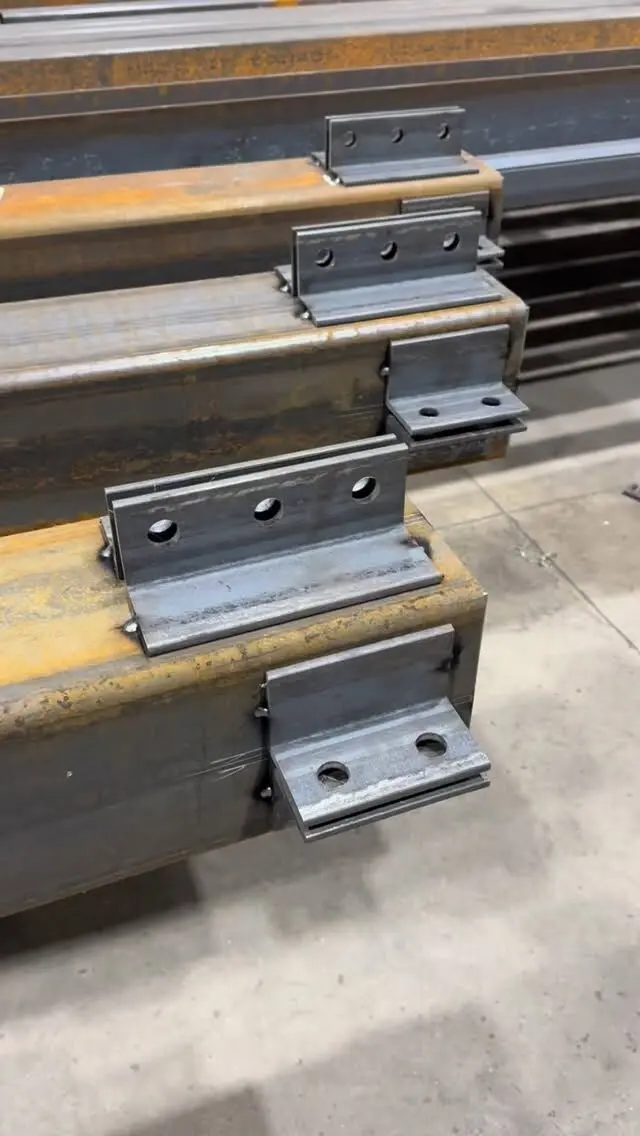
Beams for most projects need more than a cut length: end plates, cap and base plate connections, holes for bolts and wood nailers, and sometimes camber. We fabricate wide-flange beams to your shop drawings, with connections and camber as specified, and deliver them marked to match the drawings. See where to buy steel beams in Ontario for what to expect when you order.
Send us your drawings for a take-off and quote, or browse our steel products to see beams, posts, lintels and plates.
Frequently asked questions
What are the standard steel beam sizes in Canada?
Canadian wide-flange beams are designated W, then nominal depth in mm, then mass in kg/m, for example W200x27 or W310x39. Depth groups run from W100 up to W1100, and residential and light commercial work mostly uses W150 to W360.
Are H beams and W beams the same?
They are the same family. W stands for wide flange, and the heavier W sections in each depth group have flanges about as wide as the beam is deep, which gives an H profile. People often call those column sections H beams.
How do I convert a metric beam size to imperial?
Match the depth group (W200 is W8, W250 is W10, W310 is W12, W360 is W14) and then find the section with the same dimensions. For example, W250x33 is the same beam as W10x22. Use a published table rather than converting the numbers directly.
What size steel beam do I need?
That depends on the span, the loads, the deflection limit and the supports, and it has to come from a designer or engineer. A size chart tells you what a beam is, not what it can carry.