Canadian structural C-channels are named by nominal depth in millimetres and mass in kilograms per metre, so a C200x17 is a channel about 203 mm deep that weighs about 17 kg/m. Standard sizes run from C75 to C380, and each one is the same physical section as a US imperial channel (a C200x17 is a C8x11.5). The chart below lists every standard C size with its key dimensions.
How C-channel sizes are named
A channel designation has three parts:
- The letter. C means a standard hot-rolled channel (often called an American Standard Channel). MC means a miscellaneous channel, a family with different flange proportions, mostly used for heavier or special-purpose framing.
- The first number. Nominal depth in millimetres. Like beams, the nominal depth is a rounded family name, not an exact measurement. All C200 channels are 203 mm (8 in) deep.
- The second number. Mass in kg per metre, rounded. Within one depth, a heavier channel has a thicker web and slightly wider flanges, while the depth stays the same.
Canadian drawings use the metric names. American drawings, older Canadian drawings and many supplier price lists use imperial names, where the numbers are depth in inches and weight in pounds per foot. If you need a fuller explanation of how metric and imperial designations relate, see our guide on how to read steel beam sizes. The same logic applies to channels.
Standard C-channel size chart (metric)
Values are converted from the AISC Shapes Database (metric columns) and rounded. The Canadian designation rounds the mass to the nearest whole kilogram. Check final design properties against the CISC Handbook of Steel Construction or your engineer's tables.
| Designation | Imperial equivalent | Depth (mm) | Flange width (mm) | Web thickness (mm) | Mass (kg/m) |
|---|---|---|---|---|---|
| C75x6 | C3x4.1 | 76 | 35.8 | 4.3 | 6.1 |
| C75x7 | C3x5 | 76 | 38.1 | 6.6 | 7.4 |
| C75x9 | C3x6 | 76 | 40.6 | 9.0 | 8.9 |
| C100x8 | C4x5.4 | 102 | 40.1 | 4.7 | 8.0 |
| C100x9 | C4x6.25 | 102 | 41.9 | 6.3 | 9.3 |
| C100x11 | C4x7.25 | 102 | 43.7 | 8.2 | 10.8 |
| C130x10 | C5x6.7 | 127 | 44.5 | 4.8 | 10.4 |
| C130x13 | C5x9 | 127 | 48.0 | 8.3 | 13.0 |
| C150x12 | C6x8.2 | 152 | 48.8 | 5.1 | 12.2 |
| C150x16 | C6x10.5 | 152 | 51.6 | 8.0 | 15.6 |
| C150x19 | C6x13 | 152 | 54.9 | 11.1 | 19.3 |
| C180x15 | C7x9.8 | 178 | 53.1 | 5.3 | 14.6 |
| C180x18 | C7x12.25 | 178 | 55.6 | 8.0 | 18.2 |
| C180x22 | C7x14.75 | 178 | 58.4 | 10.6 | 22.0 |
| C200x17 | C8x11.5 | 203 | 57.4 | 5.6 | 17.1 |
| C200x21 | C8x13.75 | 203 | 59.4 | 7.7 | 20.5 |
| C200x28 | C8x18.75 | 203 | 64.3 | 12.4 | 27.9 |
| C230x20 | C9x13.4 | 229 | 61.7 | 5.9 | 19.9 |
| C230x22 | C9x15 | 229 | 63.2 | 7.2 | 22.0 |
| C230x30 | C9x20 | 229 | 67.3 | 11.4 | 30.0 |
| C250x23 | C10x15.3 | 254 | 66.0 | 6.1 | 22.8 |
| C250x30 | C10x20 | 254 | 69.6 | 9.6 | 30.0 |
| C250x37 | C10x25 | 254 | 73.4 | 13.4 | 37.0 |
| C250x45 | C10x30 | 254 | 77.0 | 17.1 | 45.0 |
| C310x31 | C12x20.7 | 305 | 74.7 | 7.2 | 30.8 |
| C310x37 | C12x25 | 305 | 77.5 | 9.8 | 37.0 |
| C310x45 | C12x30 | 305 | 80.5 | 13.0 | 45.0 |
| C380x50 | C15x33.9 | 381 | 86.4 | 10.2 | 50.4 |
| C380x60 | C15x40 | 381 | 89.4 | 13.2 | 60.0 |
| C380x74 | C15x50 | 381 | 94.5 | 18.2 | 74.0 |
Two patterns are worth knowing. First, the depth is fixed for each family, so going up in weight mainly thickens the web. A C250x45 has almost three times the web thickness of a C250x23 but is only 11 mm wider across the flange. Second, standard C-channels have narrow flanges with sloped inside faces, which is why they sit flat against a wall or another member on the web side but need bevelled washers if bolts pass through the flange.
Not every size is stocked everywhere. The lightest and heaviest weights in each depth, and the C380 family in general, can take longer to source. Availability varies by region and by supplier, so ask for stock sizes before you lock in a design, or let your engineer give you an acceptable alternate.
MC channels: when the standard C isn't enough
MC (miscellaneous) channels fill gaps in the standard series. Some are heavier with wider flanges than any C of the same depth; others are very light channels with narrow flanges. A few common ones:
| Imperial designation | Depth (mm) | Flange width (mm) | Web thickness (mm) | Mass (kg/m) |
|---|---|---|---|---|
| MC6x12 | 152 | 63.5 | 7.9 | 17.9 |
| MC8x8.5 | 203 | 47.5 | 4.6 | 12.6 |
| MC8x20 | 203 | 77.0 | 10.2 | 29.8 |
| MC10x8.4 | 254 | 38.1 | 4.3 | 12.5 |
| MC10x22 | 254 | 84.3 | 7.4 | 33.0 |
| MC12x10.6 | 305 | 38.1 | 4.8 | 15.8 |
| MC12x31 | 305 | 93.2 | 9.4 | 46.0 |
| MC18x42.7 | 457 | 100 | 11.4 | 63.5 |
Values are from the AISC Shapes Database metric columns, rounded. MC sections are produced in smaller quantities than standard channels and are less likely to be sitting in a Canadian service centre. If your drawings call for one, confirm availability early. A standard C or a bent plate is sometimes an acceptable substitute, but only the engineer of record can approve the change.
Where C-channels get used
Channels have one flat back and two flanges on the same side, which makes them handy wherever a member needs to sit tight against something:
- Stair stringers. Channel stringers with welded or bolted treads are a common choice for steel stairs, with the flat back facing the wall or the open side.
- Framing and trimmers. Channels frame openings in floors and roofs, act as headers between beams and support mechanical equipment.
- Bracing and struts. Light channels serve as girts, purlins and secondary bracing in industrial and agricultural buildings.
- Built-up members. Two channels back to back, or toes together and closed with plate, make a stiffer built-up section for posts and beams.
- Ledgers and edge members. Channels bolted to walls or slab edges carry joists or decking.
One engineering point to be aware of: a channel loaded through its web tends to twist, because its shear centre sits outside the web. That is why channels are usually braced, paired or loaded in a specific way. It is a design question, not something to work out on site, so always use the size and connections on the drawings.
Hot-rolled channels vs cold-formed channels
Search for "steel channel" and you'll find two very different products:
- Hot-rolled structural channels (C and MC) are rolled at a steel mill from billets or blooms. They have thick flanges and webs and are designed as structural steel.
- Cold-formed channels are bent from flat sheet or strip. Steel studs, track, some purlins and light "C-sections" fall into this group. They are much thinner, are designed under a separate CSA standard for cold-formed members and behave differently under load.
A cold-formed C with the same outside dimensions as a hot-rolled C200 carries a fraction of the load. If a drawing says C200x17, it means the hot-rolled channel.
Grades, lengths and ordering channels
Grade. Hot-rolled channels in Canada are commonly supplied to CSA G40.21 structural grades such as 300W or 350W, or dual-certified to an ASTM grade. The grade comes from the structural drawings or specification. Ask for mill test certificates if your project needs them.
Lengths. Mills roll channel in long lengths, and service centres stock it in standard imperial lengths. What is on the rack differs between suppliers and sizes, so it pays to ask. For most jobs the simpler route is to order the channel cut to your dimensions, so there is no waste to haul away and no cutting on site.
Weight. To estimate the weight of an order, multiply the total length in metres by the mass per metre from the chart. Ten pieces of C200x17 at 4.5 m each is 45 m, and 45 x 17.1 = about 770 kg. Holes, copes and welded clips add a little; trimming and copes take a little away.
When you order fabricated channel, give the supplier:
- The designation in metric or imperial, exactly as it appears on the drawing.
- The grade.
- Cut lengths and quantities, or the shop drawings.
- Holes, slots, copes, mitres and any welded plates or clips.
- Finish: mill finish, primer or galvanizing.
Getting channel cut and fabricated
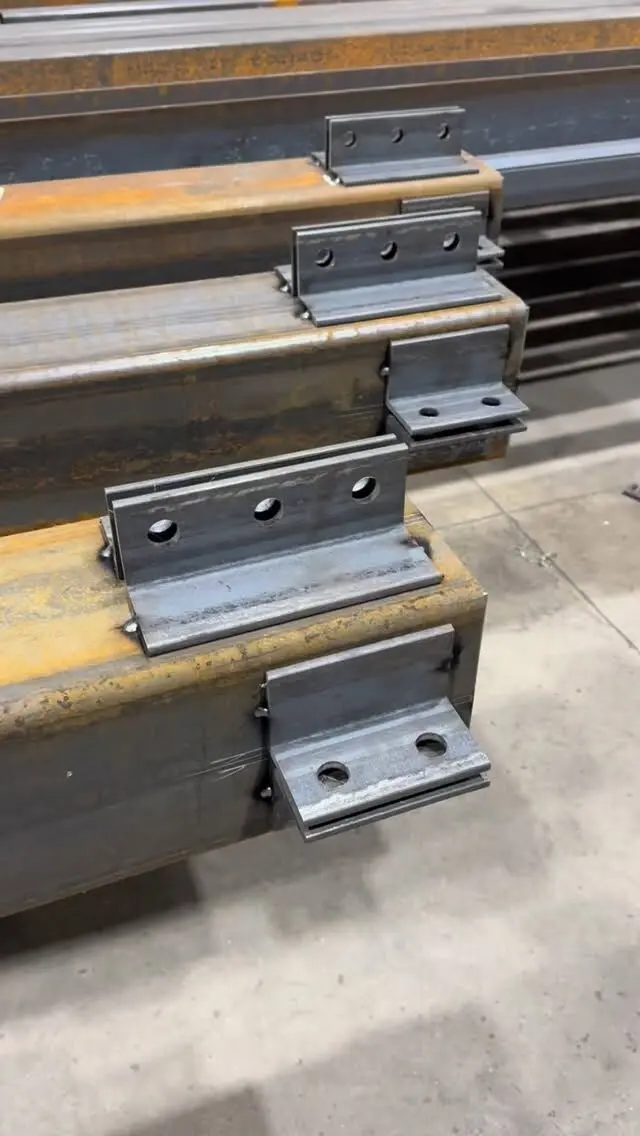
Channels rarely go on a job as plain stock. They usually need cut ends, holes and connection plates that match the rest of the frame. We supply C-channels cut and fabricated to order, along with the beams, posts and plates they connect to, so the pieces arrive marked and ready to install. Comparing shapes? See our Canadian W-shape beam chart and HSS size chart.
If you have drawings, send them over for a quote and we'll confirm the sizes we can supply. You can also browse our steel products, including beams, lintels, plates, posts and channels.
Frequently asked questions
What do the numbers in C200x17 mean?
C is a standard hot-rolled channel, 200 is the nominal depth in millimetres and 17 is the approximate mass in kilograms per metre. A C200x17 is about 203 mm deep and is the same section as the US C8x11.5.
What sizes do C-channels come in?
Standard hot-rolled C-channels run from C75 (about 76 mm deep) to C380 (about 381 mm deep), with two to four weights in each depth. MC (miscellaneous) channels add heavier and lighter options at several depths.
What lengths do C-channels come in?
Mills roll channel in long lengths and service centres stock it in standard imperial lengths, then cut to order. What is on the rack varies by supplier and size, so ask for stock lengths or order the channel cut to your dimensions.
Is a C-channel the same as a cold-formed channel or steel stud?
No. Hot-rolled C-channels are solid structural sections with thick flanges. Cold-formed channels are bent from sheet or strip, are much thinner and are designed under a different standard, so one cannot replace the other without an engineer's approval.