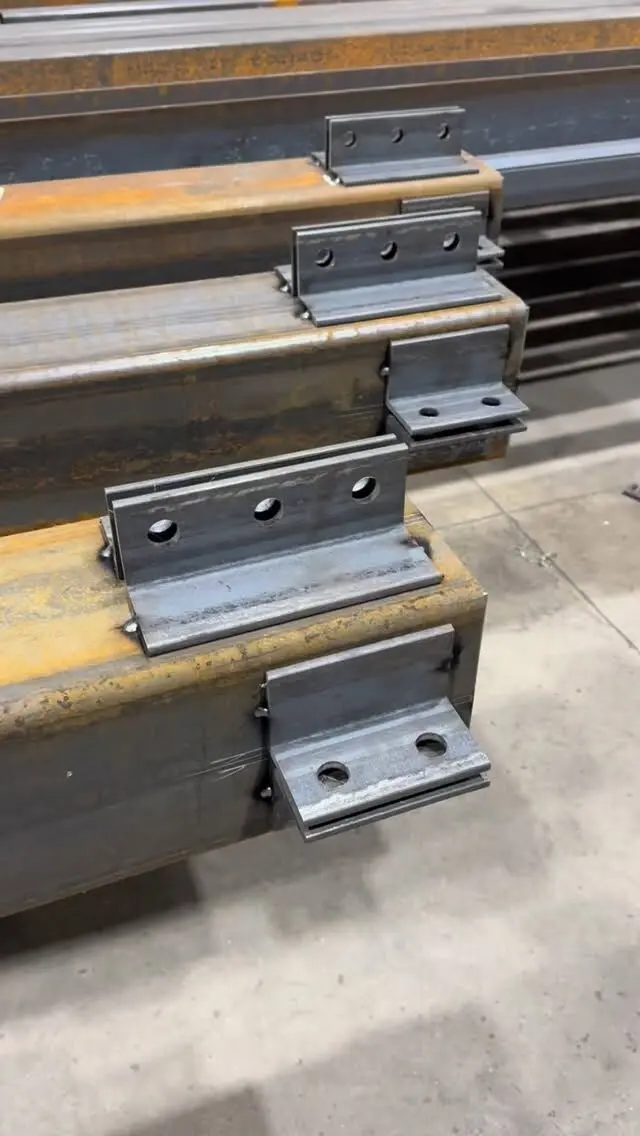
In Canada, "I-beam", "W-beam" and "H-beam" usually describe the same product: a hot-rolled wide-flange steel section, designated W on drawings (for example W200x27). People call it an I-beam when the flanges are narrow compared with the depth and an H-beam when the flanges are about as wide as it is deep. The one genuinely different shape is the S-beam, the traditional "standard I-beam", which has narrower, tapered flanges. And on a pile drawing, HP means an H-shaped pile section.
So the useful question isn't "which name is right" but "which shape and size does the job need". This guide sorts out the names, then compares the shapes on real section properties.
The names, sorted out
| Everyday name | What it usually means | Drawing designation | Example |
|---|---|---|---|
| I-beam | A wide-flange beam with flanges narrower than its depth, or loosely any beam of this family | W (sometimes S) | W250x33 |
| W-beam, wide-flange beam | A hot-rolled section with parallel-faced flanges | W | W310x39 |
| H-beam | A wide-flange section with flanges about as wide as it is deep | W | W200x46 |
| S-beam, standard I-beam, American Standard beam | An older profile with narrow, tapered flanges | S | S200x27 |
| H-pile | A bearing pile with web and flanges of equal thickness | HP | HP200x53 |
A few points that clear up most confusion:
- "I-beam" is not a designation. No Canadian structural drawing calls for "an I-beam". It calls for a W-shape, an S-shape or another specific section with a size.
- "H-beam" is not a designation either. It describes proportions. A W200x46 is 203 mm deep and 203 mm wide, so it looks like an H on its side. A W250x33 is 258 mm deep with a 146 mm flange, so it looks more like an I. Both are W-shapes.
- The W stands for wide-flange, not "weight". The numbers after it are the nominal depth in millimetres and the mass in kilograms per metre. Our guide on how to read steel beam sizes explains the naming and the metric to imperial pairs.
How the shapes actually differ
All of these sections have the same basic anatomy: two flanges that resist most of the bending and a web that holds them apart and carries shear. What changes is the proportion and the flange geometry.
W-shapes (wide-flange)
The inside faces of the flanges are parallel. That makes connections simple: bolts sit square against the flange, plates and clip angles fit flat, and wood nailers sit flush on top. W-shapes come in a wide range of depths and weights, from small W100 sections to deep W1100 girders, and within each depth family there are narrow-flange "beam" proportions and wider, squarer "column" proportions.
S-shapes (standard I-beams)
The flanges are narrower and their inside faces slope, so the flange is thicker at the web than at the tip. Bolting through a sloped flange needs bevelled washers. S-shapes were the standard rolled beam before wide-flange sections took over, so you mostly meet them in older buildings and under some hoist trolleys. W-shapes are what most suppliers stock in the widest range of sizes, so ask about availability before specifying an S-shape.
H-shaped W-sections and HP piles
When the flange width is close to the depth, the section is stiff about both axes, which is what a column wants. Many W-shapes in the W150, W200, W250 and W310 families have these proportions. HP shapes go one step further: the web is as thick as the flanges, because piles are driven into the ground and need to be robust in every direction.
Side by side: four shapes at the same nominal depth
The table compares sections around 200 mm deep. Values are from the CISC section tables (W-shapes) and the AISC Shapes Database metric columns (S and HP shapes), rounded. "Strong axis" is bending the normal way, with the web vertical; "weak axis" is bending sideways.
| Section | Imperial name | Depth (mm) | Flange width (mm) | Mass (kg/m) | Strong-axis I (10⁶ mm⁴) | Weak-axis I (10⁶ mm⁴) | Weak-axis r (mm) |
|---|---|---|---|---|---|---|---|
| W200x27 | W8x18 | 207 | 133 | 26.6 | 25.8 | 3.30 | 31.2 |
| S200x27 | S8x18.4 | 203 | 102 | 27.4 | 23.9 | 1.54 | 21.0 |
| W200x46 | W8x31 | 203 | 203 | 46.2 | 45.4 | 15.3 | 51.2 |
| HP200x53 | HP8x36 | 204 | 207 | 53.0 | 49.5 | 16.8 | 49.5 |
What the numbers show:
- W vs S at the same weight. The W200x27 and S200x27 weigh almost the same. The W-shape is slightly stiffer in normal bending and about twice as stiff sideways (3.30 against 1.54). That sideways stiffness matters whenever the beam isn't braced along its length, because a beam with weak sideways stiffness tends to twist and buckle before it reaches its full bending strength. This is the main reason the W-shape replaced the S-shape for general beams.
- Narrow W vs square W. The W200x46 weighs about 74% more than the W200x27 but is only about 76% stiffer in normal bending. As a floor beam on its own, the deeper, lighter section in another family is usually a more efficient choice. As a column, the square W200x46 is far better: its weak-axis radius of gyration (r) is 51.2 mm against 31.2 mm, and column capacity depends heavily on that number.
- HP vs square W. The HP200x53 is similar in shape to the W200x46 but heavier, with a thicker web. That extra web suits driving and bearing loads, not ordinary framing.
These are section properties, not capacities. The actual resistance of a beam or column depends on span, bracing, loads and connections, and is calculated by an engineer to CSA S16.
Which shape suits which job
Floor and roof beams. Usually a W-shape with beam proportions: deeper than it is wide. Depth is what gives bending stiffness, so for a given weight the deeper section deflects less. In houses, the Ontario Building Code's steel beam span tables list W-shapes only, and require at least Grade 350W steel to CSA G40.21 for beams designed from those tables. Our guide to steel beam span tables in Ontario explains how they work.
Columns. A squarer W-shape (the H-shaped ones) or a hollow structural section. Both are stiff about both axes. Which one wins depends on connections, appearance and loads; our comparison of W-beams and HSS covers that choice.
Matching existing steel. In renovations of older buildings you may find S-shapes. A replacement or a sister beam doesn't have to be an S-shape, but whatever goes in has to fit the existing depth, bearing and connections, and an engineer has to confirm it.
Piles. HP sections, designed by a geotechnical or structural engineer.
Light framing, ledgers and trim. Often not an I-shape at all. A C-channel sits flat against a wall on its web side, which is why channels are used for ledgers and edge members. Our C-channel vs I-beam comparison shows how much stiffness you give up for that flat back.
European and imported designations
Drawings from European designers, or imported steel, may use other names:
- IPE sections are I-shaped with parallel flanges, similar in role to a narrow-flange W-shape.
- HE sections (HEA, HEB, HEM) are wide-flange, H-shaped sections, similar in role to a square W-shape.
- IPN sections have tapered flanges, similar in idea to the S-shape.
These are not dimensional matches for Canadian W-shapes. A Canadian supplier will propose the nearest W-shape, and that substitution has to go back to the engineer of record for approval, with the section properties of both.
Common mixups when ordering
We see the same few problems over and over:
- Ordering "an 8 inch I-beam". That could be a W200x27, a W200x46 or an S200x27, which differ hugely in weight and strength. Always order by full designation from the drawing.
- Assuming H-beam means heavier. An H-shaped section is not automatically stronger as a beam. It is more balanced between the two axes, which helps columns, not floor beams.
- Measuring an old S-beam and ordering a W-shape of the same depth. Flange width, flange slope and thickness will all differ. Bearing plates, clip angles and holes made for the old beam may not fit.
- Substituting without approval. Two sections with similar depth and weight can have very different weak-axis stiffness, as the W vs S comparison above shows. Any substitution needs your designer's or engineer's sign-off.
Getting the right beam made
Whatever you call it, we'll work from the designation on your drawings. We supply wide-flange beams cut to length or fabricated with connections, holes, plates and camber as specified, with CWB certified shop welding and in-house shop drawings. If your drawings show a European or older section, we'll flag it and help your engineer find the Canadian equivalent.
Send your drawings for a free take-off and quote, see the steel beams and posts we supply, or check sizes in our Canadian W-shape beam chart.
Frequently asked questions
Are I-beams and H-beams the same?
They belong to the same family of rolled shapes with two flanges joined by a web. People say H-beam when the flanges are about as wide as the section is deep, and I-beam when the flanges are noticeably narrower than the depth. In Canada both are usually supplied as W-shapes.
Is a wide-flange beam the same as an I-beam?
In everyday use, yes: most beams people call I-beams are wide-flange (W) shapes. Strictly, the traditional I-beam is the S-shape, or American Standard beam, which has narrower flanges with sloped inside faces.
What is the difference between an S-beam and a W-beam?
An S-beam has narrow flanges whose inside faces taper, while a W-beam has wider flanges with parallel faces. At the same depth and weight, the W-shape is about twice as stiff about its weak axis and is easier to connect to.
Which is better, an I-beam or an H-beam?
Neither is better in general. A deep, narrow-flange section is more efficient for a beam bending under floor loads. A square, H-shaped section is better as a column or where the member bends both ways. Your engineer picks the shape and size.