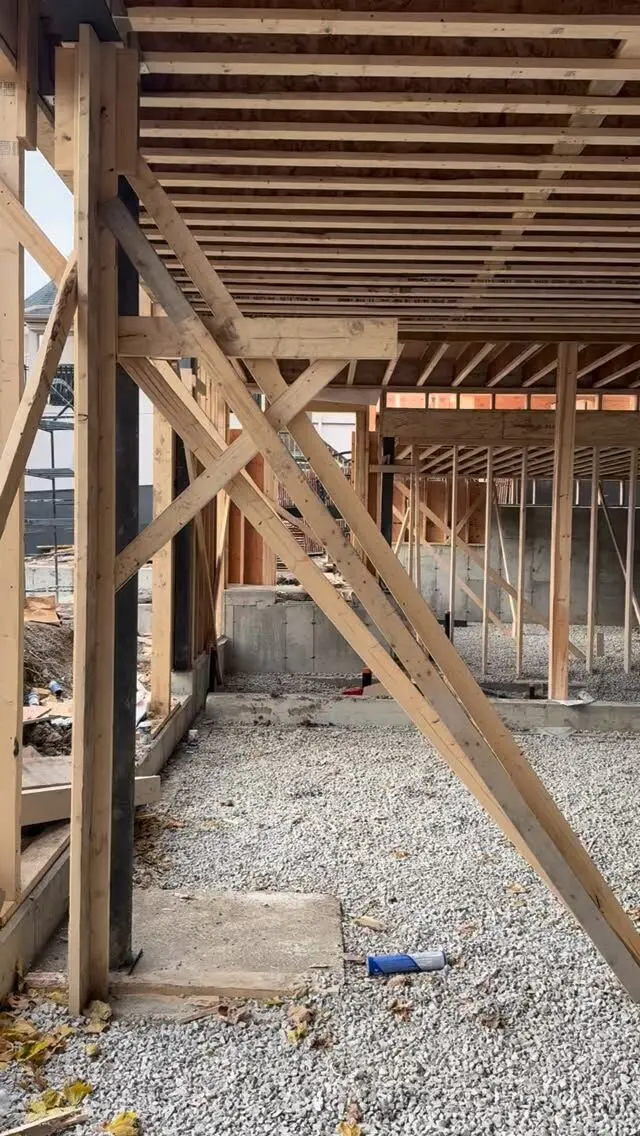
Yes, an adjustable steel column (telepost) can be a permanent basement support in Ontario, as long as it conforms to CAN/CGSB-7.2 and the load on it does not exceed 36 kN. That's Article 9.17.3.4 of the 2024 Ontario Building Code. An adjustable column that doesn't meet the standard, or that carries more than 36 kN, has to be designed under Part 4 of the code, which in practice means an engineer.
The confusion comes from two places: unlabelled jack posts sold for temporary shoring, and the large amount of American advice online written for US codes and products. Here's how it works under Ontario's code.
What the Ontario Building Code says about adjustable columns
Under the 2024 OBC (O. Reg. 163/24), Section 9.17 covers columns in houses and small buildings. The adjustable column rule is short:
- Sentence 9.17.3.4.(1): where the imposed load does not exceed 36 kN, adjustable steel columns shall conform to CAN/CGSB-7.2, "Adjustable Steel Columns."
- Sentence 9.17.3.4.(2): adjustable steel columns other than those described in Sentence (1) shall be designed in accordance with Part 4.
The edition the code references is CAN/CGSB-7.2-94. Nothing in the article limits a conforming column to temporary use. If it meets the standard and the load is within 36 kN, it's an accepted permanent support.
Section 9.17 itself has limits. It applies to columns supporting beams that carry no more than two wood-frame floors, where the supported length of joists on the beam doesn't exceed 5 m and the floor live load doesn't exceed 2.4 kPa (Article 9.17.1.1). Columns outside that scope are designed under Part 4.
The 36 kN limit and why it matters
The code's explanatory note to Article 9.17.3.4 is blunt about the risk: with the floor loads and beam and joist spans permitted in Part 9, the load on a column can exceed 36 kN, which is the maximum CAN/CGSB-7.2 covers.
The note explains how Part 9 calculates column load. Take the area of floor the column supports, which is half the joist span on each side of the beam multiplied by half the beam span on each side of the column, and multiply it by the floor live load for each floor carried. Wider column spacing, longer joists and a second storey all push the number up.
So the honest answer to "can this telepost be permanent?" is: it depends on the load it carries, and that's for your designer to confirm. A telepost under a short beam in a bungalow is in a very different position from one holding up a beam with long joists on both sides and two floors above.
Reading the label on a telepost
Markham's Building Standards department publishes a builder tip on adjustable steel columns, updated for the 2024 OBC. It describes two types that fall under the standard: a single tube with an adjustable screw, and a telescopic double tube with an adjustable screw and a support pin. It also lists what a properly labelled column should show:
- Manufacturer's name and address
- Standard number: CAN/CGSB-7.2-94
- Maximum extension (mm)
- Maximum allowable load (kN)
- Grade and yield strength of the steel
If a column has no label, or the label doesn't reference the CGSB standard, there's no easy way to show it conforms, which is why the label is the first thing to check. Painting over it causes the same problem later, so leave it visible.
The maximum extension matters too. A telescoping column pulled out past its rated extension is no longer the column that was tested.
Installation rules that apply to any steel column
Conforming to CGSB-7.2 covers the column. The rest of Section 9.17 covers how it's installed, and these apply to adjustable and fixed steel columns alike:
- On a proper footing. Columns must be centred on a footing that conforms to Section 9.15 (Article 9.17.2.1). A post sitting on a thin basement slab with no footing under it is not compliant, no matter what the label says. Column pad sizes come from Table 9.15.3.4.
- Fastened at the top. Columns must be securely fastened to the member they support to prevent lateral movement (Sentence 9.17.2.2.(1)).
- End plates. Steel columns need bearing plates at each end of at least 100 mm x 100 mm x 6.35 mm, and under a wood beam the top plate must extend across the full width of the beam (Article 9.17.3.2). The top plate can be omitted where the column supports a steel beam and there's provision for attaching the column to it.
- Corrosion. Exterior steel columns must have at least one coat of rust-inhibitive paint (Article 9.17.3.3).
The beam the column supports has its own rules, including span limits and minimum bearing. Our steel beam span tables guide covers those.
Teleposts vs fixed steel posts
The alternative to an adjustable column is a fixed steel post: a pipe or HSS section cut to length with base and cap plates welded on. For pipe columns, Article 9.17.3.1 sets a minimum outside diameter of 73 mm and wall thickness of 4.76 mm, and allows other sizes where their loadbearing capacity is shown to be adequate. Square and rectangular HSS posts are common on engineered drawings. See our HSS sizes chart for the metric sections.
| Adjustable column (telepost) | Fixed steel post | |
|---|---|---|
| Code path | CAN/CGSB-7.2, up to 36 kN | Part 9 pipe column minimums, or designed |
| Height | Set on site within rated extension | Cut to a measured length |
| Higher loads | Must be designed under Part 4 | Sized by the designer |
| Connections | Standard plates | Plates and holes detailed to the beam and footing |
| Typical use | Original basement beams, light loads | New beams, wall removals, engineered jobs |
Fixed posts usually make sense when:
- The load is over 36 kN, or the designer simply specifies a fixed post.
- A new beam is going in, such as after removing a bearing wall or opening up a basement. The engineer designs the beam, posts and footings together. See cost to install a steel beam in a basement.
- You're finishing the basement and want posts that can be boxed in without an adjustment screw or pin that someone might later tamper with.
Fixed posts need an accurate field measurement, because there is no adjustment once they're cut. That's normally done after the beam is in place and the floor above is properly supported.
When to have your basement posts looked at
Call a contractor, or a designer or engineer if changes are needed, if you see:
- No label or a label that doesn't reference CAN/CGSB-7.2
- Rust eating into the base, especially where the post sits in water or on a damp slab
- Bent, buckled or out-of-plumb columns, or a missing pin on a telescoping type
- A post on the slab with no visible footing, or a cracked slab around the base
- A loose top that isn't fastened to the beam, or shims and wood blocks stacked to make up height
Don't try to jack a sagging beam with a telepost. Lifting a structure moves loads into places they weren't before and can crack finishes, walls and foundations. Replacing a post means temporarily supporting the beam first, and moving, adding or removing posts or changing the beam is a structural alteration that needs a designer and, in GTA municipalities, a building permit.
Fixed steel posts made to your drawings
We fabricate HSS and steel posts for basements with base and cap plates welded on, along with the beams and plates they connect to. Send us your drawings or measurements for a quote, or see our steel products for what we supply and fabricate.
Frequently asked questions
Can adjustable steel columns be permanent in Ontario?
Yes, if they conform to CAN/CGSB-7.2, Adjustable Steel Columns, and the load on them does not exceed 36 kN. Article 9.17.3.4 of the 2024 Ontario Building Code allows that. Adjustable columns outside those limits must be designed under Part 4.
How do I know if my telepost is approved for permanent use?
Look for the manufacturer's label. A CGSB-conforming column should be labelled with the manufacturer's name and address, the standard number CAN/CGSB-7.2-94, the maximum extension, the maximum allowable load and the steel grade and yield strength.
Are lally columns adjustable?
Lally column is a US term for a steel pipe column, traditionally fixed-length and often concrete-filled. Adjustable steel columns, called teleposts in Canada, have a screw or a telescoping tube and pin so the height can be set on site.
Should I replace teleposts with fixed steel posts?
Not automatically. Labelled CGSB columns within their load rating are permitted. Fixed steel posts are common when loads exceed 36 kN, when an engineer designs a new beam, or when the owner wants a cleaner, non-adjustable support.